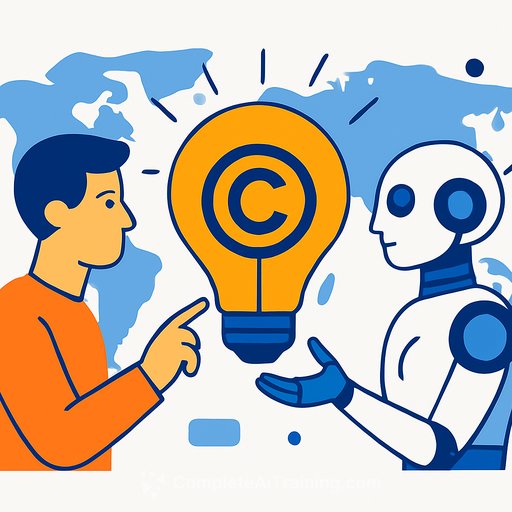
Generative AI is forcing a rethink of authorship, ownership, and creative rights
If you make a living from your voice, style, or aesthetic, AI just changed the ground under your feet. The issue isn't blatant copying. It's semantic imitation-machines learning your patterns and reproducing your creative identity at scale.
New Research shows copyright law isn't built for this. It was written for human authors, clear intent, and recognizable expression. AI can hit the same meaning and vibe without lifting a line, and that slips past most legal tests.
Where current law breaks: US, UK, Germany
United States: AI-only works don't get copyright. That's clear. What's not clear is who owns hybrid work when your input, prompts, edits, and curation blend with machine output. Creators and publishers are stuck with uncertainty on ownership, attribution, and liability.
United Kingdom: The law recognizes "computer-generated works" and assigns authorship to the person who made the necessary arrangements. It's pragmatic, but it sidesteps originality and ignores semantic imitation. It risks weakening the idea that human creativity is the core of protection.
Germany: Stronger human-centered doctrine and moral rights. Better posthumous safeguards too. But style imitation, voice mimicry, and identity cloning still fall outside traditional infringement tests, leaving creators exposed.
The training data blind spot
Across all three systems, there's no clean answer on scraping copyrighted works for training. Is it infringement, fair use, or permitted data mining? Courts often treat training as a technical process instead of semantic learning.
Result: models absorb and reproduce creative identities at industrial scale without clear authorization or compensation. Creators get displaced and can't point to a dependable remedy.
Originality and moral rights are the weak points
Copyright focuses on expression, not style. So AI can replicate the feel of your work and compete with you directly without triggering a violation. Economically and culturally, that hits hard.
Moral rights aren't keeping up either. In common law countries they're narrow. In civil law countries they're stronger but still built for analog disputes, not algorithmic imitation. Posthumous voices are especially vulnerable.
MATH-COPE: mapping the failure
The research introduces the MATH-COPE framework to track where law and practice fall short. It looks at four legal themes-moral rights, authorship and originality, training data and copyright, and human originality-across four contexts: commercialization, organizational practice, policy and governance, and ethical technology.
Bottom line: legal gaps are multiplied by platform incentives, fragmented rules, and opaque AI development.
What a better framework looks like
The study proposes a global approach that keeps the foundations of copyright but updates them for AI. The core shift: protect human semantic originality, not just arrangement of words or pixels. AI-only outputs are excluded from authorship. AI-assisted works can qualify when meaningful human creative control is proven.
- Structured licensing for training data, with authorization and compensation. Both input-based and output-based models are on the table.
- Modernized moral rights that cover AI-driven imitation of style, voice, and likeness, including explicit posthumous protections.
- Layered transparency: disclosures and audit access that don't blow trade secrets.
- Enforceability: provenance tracking, watermarking, and metadata standards as platform responsibilities.
- Cross-border rules to reduce forum shopping and inconsistent outcomes.
- Operational rails: registries for training permissions, standard licensing channels, and proportionate compliance for small studios and freelancers.
What this means for creatives right now
- Document your human contribution. Keep drafts, prompts, edit logs, and version history. You may need to show creative control for protection and contracts.
- Update contracts: require AI-use disclosure, set boundaries on training and style mimicry, and add indemnities for AI-origin risk in client work.
- License your style on your terms. If clients want "in the style of," price it, scope it, and limit reuse and training rights in writing.
- Use provenance tools. Adopt watermarking and content credentials where possible (see the C2PA standard).
- Control data exposure. Use opt-out tags, platform settings, and dataset opt-out forms when available. Don't feed sensitive work into public models without terms.
- Register key works with your local copyright office. It strengthens enforcement and deters casual misuse.
- Monitor marketplaces and social platforms. Set alerts for your name and signature styles. Act early on impersonation or deceptive labeling.
- Join collective action. Support guilds, coalitions, and licensing schemes that negotiate fair training access and rates.
- Educate clients and collaborators. Explain the legal gray zones and the business risk of unlicensed AI use.
Where policy is heading
Expect momentum toward licensed training, clearer rules for hybrid authorship, stronger style and likeness protections, and platform-level provenance. The push is to keep AI as a tool-not a co-author-while restoring economic fairness and cultural trust.
If you build a practice around human meaning and can show it, you're better positioned for the next wave of rules and commissions.
Helpful resources
- U.S. Copyright Office policy on AI authorship: copyright.gov/ai
- WIPO on AI and copyright policy: wipo.int
- AI Learning Path for Data Scientists - practical courses and guidance for building AI skills without giving up authorship.
Your membership also unlocks: