
AI news ·
Whistleblower gaps, visa surveillance, and AI deepfakes expose limits of U.S. privacy law
Thomas Drake faced 10 felony Espionage Act counts in 2010 for telling a reporter about a surveillance program he believed wasted taxpayer money. The charges were dropped, but his career and finances were destroyed.
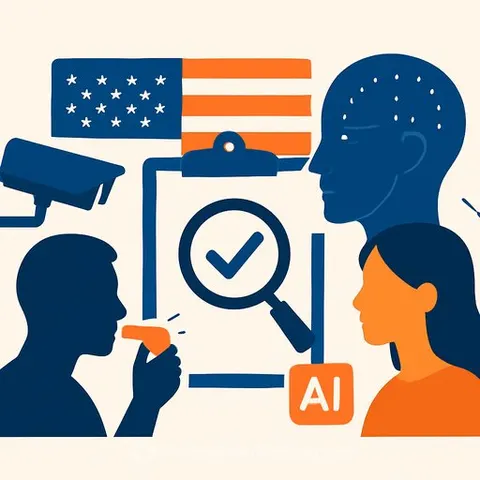
Whistleblowers Face Espionage Charges While Privacy Law Fails
A senior NSA executive named Thomas Drake faced ten felony counts under the Espionage Act in 2010. His offense: telling a reporter about a surveillance program he believed violated civil liberties and wasted taxpayer money. The charges were eventually dropped, but Drake's career ended and his finances were destroyed. His case is not unique.
The legal system protecting government whistleblowers contains a critical gap. Congress passed the Whistleblower Protection Act in 1989 and strengthened it in 2012, but both laws exclude intelligence employees. Instead, intelligence workers fall under the Intelligence Community Whistleblower Protection Act of 1998, which limits them to reporting through the Inspector General or congressional committees. The law tells them how to speak, but does not protect them once they do.
The Espionage Act of 1917 was written to prosecute spies and foreign agents. Courts now use it against whistleblowers. The law does not require prosecutors to prove intent to harm the United States. It does not allow defendants to argue their disclosures served the public interest. The government needs only to prove information was disclosed improperly.
Drake followed the rules. He raised concerns internally about a program called Trailblazer, then contacted the Baltimore Sun without disclosing classified information. The Department of Justice charged him under the Espionage Act anyway. Years of litigation followed. When the government can use espionage charges as a deterrent, national security becomes a political standard rather than a legal one.
Reforming the Espionage Act faces resistance from intelligence officials and courts. A public interest defense for whistleblowers or a requirement to prove harmful intent would reduce prosecutorial power. The government has little incentive to support such changes. Until protection is made explicit, intelligence employees will be discouraged from reporting abuse.
U.S. Visa Applicants Face Ideological Screening Through Social Media
The Trump administration ordered diplomats to screen the social media of all foreign nationals applying for student and educational visas. By late 2025, the State Department had revoked 85,000 visas across all categories-nearly four times the previous year's rate. The legal framework governing this surveillance is built on outdated assumptions about how government monitors people.
The Supreme Court's 1967 decision in Katz v. United States established that the Fourth Amendment protects against warrantless searches when a person has a reasonable expectation of privacy. But Smith v. Maryland in 1979 limited this protection: information voluntarily shared with third parties has no Fourth Amendment protection. Most data collected online falls outside constitutional protection.
Noncitizens abroad have even fewer protections. In Department of Homeland Security v. Thuraissigiam (2020), the Supreme Court held that noncitizens at or near the border possess only statutory rights granted by Congress, not full constitutional protections. The Plenary Power Doctrine gives Congress and the Executive nearly unchecked authority over immigration.
The State Department expanded social media screening in December 2025 to include H-1B visa applicants and their dependents, as well as F, M, and J visa holders. The department instructed applicants to set all social media profiles to public. This requirement forces applicants to waive privacy interests before they have legal standing to claim privacy rights in the United States.
An internal State Department memo instructed consular officers to deny visas to people "responsible for, or complicit in, censorship or attempted censorship of protected expression in the United States." In practice, this has targeted workers in content moderation and online safety-the very professionals working to protect free expression. These denials constitute viewpoint discrimination based on professional work, not security threats.
Applicants have little recourse. The doctrine of consular nonreviewability, established in Kleindienst v. Mandel (1972), limits judicial review to whether a consular officer provided a "facially legitimate and bona fide reason" for denial. Applicants denied on viewpoint-discriminatory grounds have no meaningful legal remedy.
A federal court in American Association of University Professors v. Rubio (2025) ruled that noncitizens physically present in the United States have First Amendment protections. But that protection applies only after arrival. For visa applicants located abroad, First Amendment protections are largely unavailable. Viewpoint discrimination against overseas applicants cannot be meaningfully challenged in U.S. courts.
Closing this gap would require congressional legislation extending statutory privacy protections to visa applicants abroad, or courts narrowing the doctrine of consular nonreviewability to permit review of viewpoint-discriminatory denials. Without either, the government operates in a constitutional vacuum of its own making.
EU's Authorization Model Offers Stronger Privacy Protection Than Argentina's Approach
Governments worldwide are debating how to regulate artificial intelligence in law enforcement. Predictive policing-using machine learning to forecast crime based on historical data-has become central to this debate. The European Union and Argentina have taken opposite approaches, with significant implications for privacy rights.
The EU introduced the AI Act in 2021, establishing a risk-based classification system. High-risk systems require approval before deployment. Prohibited systems cannot be used at all. Critically, any AI system that profiles people based on their personal characteristics is automatically high-risk. Biometric identification systems are broadly prohibited.
The EU does allow police to use biometric AI in urgent situations-defined as substantial and imminent threats to people where irreparable damage would occur without it. Police must obtain special judicial or independent administrative authorization. If used without prior authorization, police must request approval within twenty-four hours. If denied, they must immediately cease use and delete all data. This mirrors the Fourth Amendment's warrant requirement: an independent check must stand between state surveillance power and the individual.
Argentina took the opposite path. In 2024, the Ministry of Security created an Artificial Intelligence Unit Applied to Security (UIAAS). The unit patrols the dark web, analyzes real-time surveillance images for facial recognition, and uses historical data to predict future crimes. There is no requirement for judicial authorization before deployment.
Argentina's approach conflicts with U.S. privacy precedent. Katz v. United States protects a reasonable expectation of privacy. Carpenter v. United States (2018) strengthened this by holding that aggregated digital data, even from public behavior, requires a warrant. Argentinian predictive policing would fail this standard.
Predictive AI based on historical crime data leads to overpolicing. Past data guides modern enforcement. Biased historical information becomes embedded in the model's predictions. This fails the probable cause requirement for obtaining a warrant.
Racial bias in policing is already pervasive in the United States. Following Argentina's model would amplify this problem. The U.S. should require judicial authorization before deploying AI biometric surveillance, following the EU's authorization-based model. A national regulatory framework would prevent selective implementation across states, which could raise Fourth Amendment claims.
Courts Protect Deepfake Content While Victims Lack Legal Tools
AI-generated deepfakes-machine-created images, videos, and audio that replicate realistic likenesses of individuals-pose threats to human dignity and democracy. Yet the courts have used the First Amendment to protect this content without accounting for its realistic nature.
Deepfakes enable disinformation, financial crime, and sexual violence. One study found that 96 percent of deepfake videos online are nonconsensual pornography. Training people to recognize deepfakes is not viable; synthetic media has become too advanced for human senses to detect.
Supreme Court precedent holds that false statements are constitutionally protected unless they cause narrow, recognized harms like defamation or fraud. In United States v. Alvarez (2012), the Court struck down the Stolen Valor Act, which prohibited falsehoods about military honors. Courts have followed this precedent, often invalidating state laws regulating false content in political advertisements.
Congress passed the Take It Down Act on May 19, 2025, criminalizing nonconsensual publication of intimate images and videos, including digital forgeries. The 2022 Violence Against Women Act allows depicted individuals to sue disclosing parties but does not address digitally altered content. Since the Take It Down Act does not amend VAWA, courts must decide whether intimate digital forgeries qualify. By not explicitly addressing altered content, VAWA leaves victims without sufficient legal protection.
Before the 2024 presidential election, California passed Assembly Bill 2839, the most aggressive U.S. law regulating AI content. It banned deepfakes of political candidates. The law was a direct response to Elon Musk sharing an altered deepfake of Kamala Harris's campaign advertisement.
In Kohls v. Bonta (2024), the U.S. District Court for the Eastern District of California declared AB 2839 unconstitutional. The court said the law violated the First Amendment because it restricted core political speech. The standards for mandatory disclaimers were deemed vague. The deepfake video was declared protected parody.
This ruling reveals a flaw in applying traditional free speech precedent to hyperrealistic deepfakes. Traditional parody is clearly distinguishable from reality. Hyperrealistic deepfakes are not. A reasonable viewer cannot easily categorize synthetic parody as fiction. The consequences of harmful deepfakes are more severe than traditional parody, yet courts apply the same free speech protections.
Political deepfakes, commercial exploitation, and disinformation remain unaddressed by current law. As long as courts treat synthetic media the same as traditional speech, the regulatory gap will widen as the technology improves. Courts should establish distinct standards for synthetic parody that account for its capacity to deceive.
What This Means for Legal Professionals
These four issues-whistleblower protection, visa surveillance, AI policing, and deepfakes-reflect a common problem: legal frameworks built for an earlier era struggle to address modern technology. For lawyers and legal professionals, this creates both challenges and opportunities.
Understanding these gaps is essential. Clients may face surveillance they don't know about. Regulations may conflict across jurisdictions. New technologies may not fit existing legal categories. Professionals working in immigration, national security, technology, and media law need to understand how current doctrine applies-and where it fails.
The legal system is beginning to adapt. Courts are developing new interpretations. Legislatures are passing targeted laws. But change is slow. In the meantime, individuals and organizations operate in zones where legal protections are unclear or absent.
Professionals who understand these emerging issues-and the gaps in current law-will be better equipped to advise clients and advocate for necessary reforms.