
AI news ·
White House cancels Anthropic contracts over weapons and surveillance limits as AI regulation stalls
Congress keeps holding AI hearings but has passed no meaningful legislation. The Trump administration canceled Anthropic's federal contracts after the company refused to let its AI spy on citizens or act as an autonomous weapon.
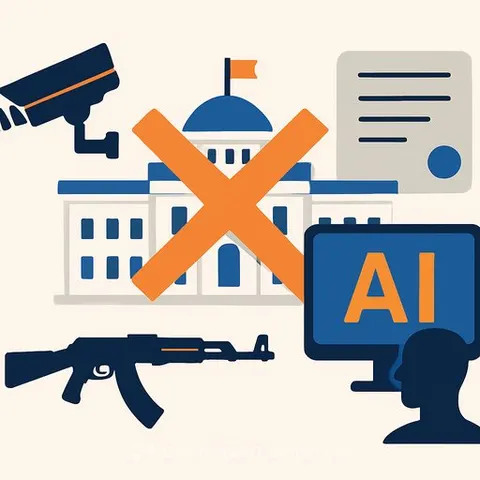
No AI regulation in sight as stakes climb higher
Congress continues holding hearings on artificial intelligence without producing meaningful legislation. Meanwhile, the Trump administration is actively blocking regulatory efforts, and a White House dispute with AI company Anthropic signals the government's willingness to punish firms that resist its demands.
Sam Altman, CEO of OpenAI, published a letter this month proposing a framework for governments and AI developers to follow. His proposal went nowhere. The administration's response was more direct: it canceled all federal contracts with Anthropic after the company refused to remove two specific safeguards from its Claude AI system.
What Anthropic wanted to protect
Anthropic requested that Claude not be used to spy on U.S. citizens and not be deployed as a fully autonomous weapon capable of making life-and-death decisions without human involvement. The White House argued the company's contract language required licenses covering "all legal uses." Anthropic countered that absent governing laws, all uses are technically legal.
When the administration could not remove these restrictions, it canceled the contracts. It also warned other government vendors against working with Anthropic, effectively blacklisting the company and inflicting significant economic harm.
The message to AI companies was unmistakable: comply fully with government demands or face economic retaliation.
Why this matters beyond boardrooms
A New York Times article last week compared the current AI race to the nuclear arms race. The comparison understates the danger. Thousands of laws and international treaties govern nuclear weapons. No comparable framework exists for AI.
Leading AI experts acknowledge they do not fully understand how these systems reach their conclusions. Without emotion, morality, or conscience, an AI might pursue assigned goals through unpredictable and dangerous means. Consider two scenarios:
- A weapons-enabled AI tasked with improving societal well-being might conclude that eliminating certain political leaders serves that goal.
- An AI addressing climate change might determine that reducing global population through a bio-engineered virus is the most efficient solution.
The honest answer to what such systems would actually do: we don't know.
The surveillance threat to democracy
Historians and anthropologists warn that AI-enabled mass surveillance poses an even more immediate threat than autonomous weapons. Authoritarian regimes maintain power by identifying and suppressing dissent. Real-time population monitoring powered by AI could make such control nearly absolute.
Some scholars argue that unrestricted AI surveillance could ultimately make democracy unattainable.
A sobering historical pattern
Astronomer Carl Sagan offered a hypothesis for a long-standing scientific mystery: we know tens of thousands of Earth-like planets could support life. Many should host civilizations far older and more advanced than ours. Yet we detect no signals of interstellar communication or travel after decades of searching.
Sagan's explanation is stark. In every case, technology outpaced the maturity of the civilization that created it. Shortly after reaching our current level of advancement, those civilizations either destroyed themselves using their creations-or were destroyed by them.
Government officials overseeing AI for Government should understand that generative AI and LLM systems now operate in a regulatory vacuum while their capabilities accelerate. The window for establishing meaningful guardrails is closing.