White House Pauses Draft Order to Preempt State AI Laws
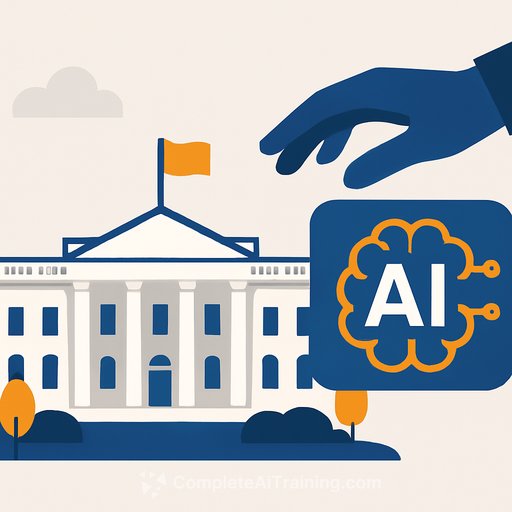
The White House has put a draft executive order on hold that sought to override state AI laws through federal litigation and by conditioning certain federal funds. The move would have likely triggered immediate resistance from states, but its consideration signals how far the administration is willing to go to address what industry calls a patchwork of conflicting rules.
The White House had no comment as of Friday. Earlier in the week, an official said any discussion of executive orders is speculative until formally announced.
What the Draft Order Proposed
The draft would have tasked Attorney General Pam Bondi with creating an "AI Litigation Task Force" to challenge state AI laws. The stated grounds included unconstitutional regulation of interstate commerce, federal preemption, or other legal defects.
It also would have directed the Department of Commerce to review state AI statutes and issue guidance that, in some cases, could withhold broadband funding based on state regulatory approaches.
Funding Leverage and Federalism Clash
Earlier this year, the Senate voted 99-1 against an effort to block state AI laws. A prior version of that measure would have denied states access to the $42 billion Broadband Equity, Access and Deployment (BEAD) program if they regulated AI. Bipartisan state officials-legislators and attorneys general-pushed back, citing risks to consumer protection, deepfakes, and child safety.
Despite the Senate vote, the issue resurfaced after President Trump backed adding a similar preemption-style provision to the National Defense Authorization Act (NDAA). Tech heavyweights, including Google, OpenAI, and Andreessen Horowitz, have urged federal preemption, arguing fragmented rules slow innovation.
More on the BEAD program (NTIA)
States Move Ahead: California's Disclosure Law
California Governor Gavin Newsom recently signed a law requiring AI safety disclosures. That statute could become an early test case if federal challenges proceed.
Political Fault Lines
Reaction came fast. Rep. Marjorie Taylor Greene opposed the draft approach: "States must retain the right to regulate and make laws on AI and anything else for the benefit of their state. Federalism must be preserved."
Sen. Amy Klobuchar called the draft "unlawful," saying it would "attack states for enacting AI guardrails that protect consumers, children, and creators - including by threatening high-speed internet for rural communities."
Robert Weissman of Public Citizen said AI is already causing harms, calling it "almost unfathomable" for the administration to block state rules. He added: "For all his posturing against Big Tech, Donald Trump is nothing but the industry's well-paid waterboy."
Key Legal Questions for Counsel
- Preemption without Congress: An executive order cannot by itself preempt state law. Any federal preemption argument will hinge on existing statutes or valid agency regulations. Expect disputes over conflict preemption and the scope of any claimed federal authority over AI.
- Dormant Commerce Clause: DOJ challenges would likely argue certain state AI rules burden interstate commerce or regulate extraterritorially. State defenses will lean on consumer protection, fraud prevention, and public safety, with Pike-style balancing front and center. Dormant Commerce Clause overview (LII)
- Spending Clause limits: Conditioning broadband funds (e.g., BEAD) on AI policy raises South Dakota v. Dole and NFIB v. Sebelius issues: clear notice, relatedness, and coercion. Adding new conditions post-enactment also invites Administrative Procedure Act and "major questions" arguments.
- Tenth Amendment/anti-commandeering: The federal government can incentivize via funding, but it cannot direct states to legislate or enforce federal policy. Expect states to frame aggressive conditions as de facto commandeering.
- Litigation posture: Look for DOJ affirmative suits against states, requests for preliminary injunctions, and industry-side parallel actions. Standing, ripeness, and as-applied vs. facial challenges will matter, especially where state laws are nascent or not yet enforced.
Practical Steps for Legal Teams
- Map exposure: Inventory state AI obligations (safety disclosures, model transparency, deepfake labeling, child-protection rules) against your product and data flows.
- Plan for dual-track compliance: Build a baseline program that meets the strictest state standards, with toggles for jurisdictional differences to reduce conflict risk.
- Contract language: Update vendor and customer agreements for AI use, audits, incident response, and content provenance. Include jurisdiction-specific addenda.
- Funding risk: If your organization relies on broadband grants, model scenarios where access tightens or pauses. Engage early with state broadband offices.
- Regulatory engagement: Prepare comments for any Department of Commerce guidance or rulemaking. Preserve arguments on statutory authority and federalism.
- Litigation readiness: Draft playbooks for Dormant Commerce Clause and preemption claims, and for defending state enforcement actions. Identify expert witnesses on technical feasibility and compliance burden.
- Monitor Congress: Track NDAA negotiations and any attempts to attach AI preemption via appropriations or riders.
What to Watch Next
- Whether an "AI Litigation Task Force" is formally announced and funded.
- Any Commerce Department guidance linking AI policies to broadband dollars.
- Text and trajectory of NDAA amendments addressing state AI laws.
- Early suits targeting California's disclosure law and similar statutes.
- State coalitions forming to defend AI rules and protect grant eligibility.
Bottom line: the order is paused, not dead. Counsel should prepare for a federal-state contest over who sets the ground rules for AI-and whether funding becomes the lever to enforce it.
Your membership also unlocks: