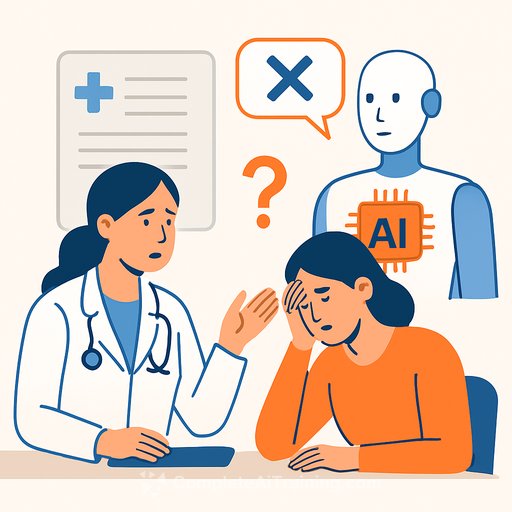
AI in Healthcare: Accountability first, deployment second
Two big announcements put generative AI back on your agenda. OpenAI introduced ChatGPT for Healthcare, and Anthropic's Claude is now embedded in Elation Health's clinical insights. Health systems like AdventHealth, Boston Children's, Cedars-Sinai, HCA, Memorial Sloan Kettering and Stanford Medicine are exploring these tools. Elation reports clinicians are getting answers 61% faster when using Claude-powered summaries.
Speed and scale matter. But the critical questions haven't changed: Who is accountable for AI-influenced decisions, and what evidence will defend those decisions if they're challenged?
What's actually useful right now
AI shines before and after the point of care. Think chart prep, record summarization, patient message drafts, coding support and process improvement. As Dr. Chase Feiger put it, success won't come from model quality alone - it hinges on disciplined governance, accountability and AI for Operations practices like rollout checklists and monitoring.
Diagnostic use is the hottest area of interest for consumers and clinicians, but it's also the riskiest for institutions. Models can sound certain while being wrong. That tone carries weight in clinical environments and creates exposure if boundaries are unclear.
The risk you can't outsource
Experts called out the gap: large language models may provide clinically confident answers, yet they bear no clinical liability. Adam de la Zerda warned that patients can anchor on authoritative summaries that lack professional nuance. Ali Diab noted that NLP-driven recommendations raise hard questions about responsibility if the analysis is wrong.
Vendors promise encryption and PHI separation. Good-baseline, not finish line. The bigger issue is decoupling certainty from accountability. Your policies must prevent an algorithm from quietly replacing human judgment.
Governance questions to answer before rollout
- Who is accountable for decisions influenced by AI-the individual clinician, the department, the vendor or the hospital?
- What documentation will you need to defend AI-influenced decisions in malpractice or peer-review proceedings?
- Which domains (pediatrics, pregnancy, rare diseases, complex meds) are restricted until accuracy is proven?
- What is the human-in-the-loop requirement for each workflow, and how is override documented?
- How will you detect, log and remediate accuracy failures and near misses?
- What's your change-control process for model updates, prompts and integrations?
Practical guardrails for clinical use
- Scope: Keep LLMs in summarization, recall, reasoning support and documentation-never as autonomous decision-makers.
- Disclosure: Make AI usage and limitations explicit to clinicians and patients. Separate consumer experiences from enterprise use.
- Validation: Prospective testing on your data, with special focus on edge cases and high-risk populations.
- Accountability: Define an executive owner, service-line leads and a clear RACI for AI decisions.
- Evidence: Store prompts, model versions, inputs and outputs in the record where clinically relevant.
- Contracts: Require auditability, incident response cooperation and indemnification aligned to risk.
- Training: Teach clinicians failure modes (confident errors, subtle omissions, reference fabrication) and when to ignore AI.
Where leading tools fit today
OpenAI's ChatGPT for Healthcare is being used to reduce administrative burden and integrate medical evidence into care team workflows. Anthropic's Claude, via Elation Health, is speeding up chart comprehension with full-record summaries. Both approaches help teams reclaim time and improve information access without handing over clinical judgment.
Most leaders agree: use AI upstream (intake, triage, data prep) and downstream (patient-friendly summaries, discharge education), not autonomously at the decision point.
Regulatory outlook (and why HIPAA is not enough)
HIPAA covers privacy, not clinical safety. If AI influences diagnosis or treatment, you're in medical device territory. The FDA's Software as a Medical Device (SaMD) guidance is a useful reference point for risk management and evidence expectations. See the FDA overview here: Software as a Medical Device.
Some countries treat certain AI applications as higher-risk devices requiring approval. Expect more scrutiny as consumer-facing tools become part of self-diagnosis. Proactive engagement with regulators is not a burden-it's an insurance policy.
A straightforward rollout checklist
- Define accountable owners and approval gates per workflow.
- Segment use cases: admin vs. clinical; consumer vs. enterprise.
- Add clear clinician-in-the-loop steps with documented overrides.
- Stand up monitoring: accuracy by cohort, near-miss rate, override rate, time saved.
- Capture an immutable audit trail (inputs, outputs, model metadata).
- Run tabletop exercises for "provably wrong" outputs and patient harm scenarios.
- Negotiate vendor terms for uptime, incident response and liability.
- Deliver role-based training and certify competency before access.
Bottom line
AI can help close the access gap and cut noise from the clinical day. But responsibility can't be vague, and boundaries can't be implied. Set governance first, limit use to where it's safe, and make accountability visible in the record. That's how these tools help patients without putting your organization at risk.
Team enablement
If you're formalizing AI training by role and workflow, you can explore concise programs here: Complete AI Training - Courses by Job.
Your membership also unlocks: