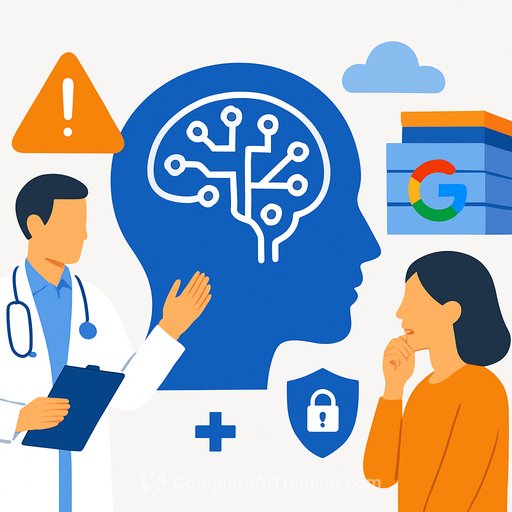
WHO: AI could undermine safety and privacy in healthcare - what you need to know (and do)
AI is moving fast across European healthcare, but WHO Europe says we're outpacing our guardrails. The big risks: patient safety, data misuse, and overreliance on tools that aren't ready for high-stakes decisions.
The benefits are real-lighter workloads, more consistent care, lower costs-but adoption is uneven and trust is fragile. If you work in healthcare, this is the moment to build structure before scale.
What WHO Europe found
Adoption is high in diagnostics and patient-facing chatbots across 50 countries surveyed. It's much lower in prognosis prediction, symptom checking, and surgery.
Only 20% of countries have guidelines for using patient data in AI. Just 28% have ethical frameworks for AI companies. That gap invites privacy violations and unsafe outcomes.
Where AI helps right now
Early deployments are reducing manual load for clinicians, smoothing patient flow, and trimming operational costs. Some systems report narrower care gaps across regions and facilities.
But the wins sit next to risks that compound quickly without governance.
The risks you must manage
- Biased or unsafe outputs from low-quality or unrepresentative training data.
- Privacy exposure and unclear consent flows for secondary data use.
- Overreliance on AI recommendations without clinician oversight.
- Limited infrastructure and thin training data leading to wrong treatment suggestions.
- Low public trust-amplified by AI bias seen in other sectors.
- Gaps in legal accountability and workforce readiness.
"The gaps in legal accountability, uneven investments in workforce development and emerging risks of exclusion underscore the need for continued vigilance, cooperation and learning," said Hans Henri Kluge, WHO Europe's regional director. "Equity must remain our guiding principle."
Practical safeguards for hospitals, clinics, and health systems
- Establish an AI governance group (clinical, data, IT, legal, patient reps). Give it authority over approvals, monitoring, and incident response.
- Set strict data-use rules: consent models, de-identification, access control, audit logs, and sunset clauses for data reuse.
- Validate every model locally. Check performance by subgroup (age, sex, ethnicity, comorbidities). Document failure modes and contraindications.
- Keep a human in the loop for any diagnostic, triage, or treatment output. Require rationale visibility when available.
- Monitor in production: drift tracking, periodic revalidation, and clear stop criteria if safety or accuracy drops.
- Vendor due diligence: request model documentation, training data provenance, bias testing, cybersecurity posture, and update policies.
- Be transparent with patients. Explain where AI is used, limits, and escalation options to a clinician.
- Invest in workforce training: clinical prompts, critical appraisal of outputs, privacy basics, and escalation protocols. Consider structured paths for different roles.
- Align with emerging regulation and ethics guidance. Prepare now for stricter transparency and risk-class rules.
For foundational guidance, see the WHO guidance on AI ethics for health and the European Commission's page on AI policy and regulation.
Trust is the hard part
WHO's survey shows people don't want AI driving impactful care decisions without strong oversight. Bias seen in finance, hiring, and policing doesn't inspire confidence at the bedside.
Trust follows transparency, local validation, and clear accountability. Show your process, not just performance claims.
Google's new AI center in Taiwan: why it matters to healthcare IT
Google opened its largest overseas AI infrastructure hub in Taiwan, drawn by talent and a chip supply chain led by TSMC. This sits inside a bigger U.S.-China race over AI hardware, export rules, and compute access.
For healthcare, this affects cloud capacity, model training costs, and vendor timelines. Expect tighter competition with Nvidia, more options for accelerators, and potential supply shocks-plan procurement and capacity with redundancy in mind.
What to do next
- Inventory all AI use (including "shadow" tools). Classify by risk. Turn off or sandbox anything without oversight.
- Create a short AI approval form: purpose, data used, validation results, clinical owner, monitoring plan, and rollback steps.
- Start with low-risk automations (documentation, administrative workflows) while you build governance for higher-risk use.
- Publish a patient-facing AI usage notice. Keep it plain language.
- Schedule quarterly safety reviews and public metrics: accuracy, overrides, incidents, corrective actions.
The bigger picture
AI can help clinicians do more of the work that matters. But safety and equity won't happen by accident.
As Pope Leo XIV put it, "If AI is to serve human dignity and the effective provision of healthcare, we must ensure that it truly enhances both interpersonal relationships and the care provided." Build your systems to make that real.
Upskilling your team
If you're setting up training tracks for clinicians, data teams, or managers, explore role-based options at Complete AI Training.
Your membership also unlocks: