AI Regulation Showdown: The Federal vs. State Fight That Will Define AI Governance
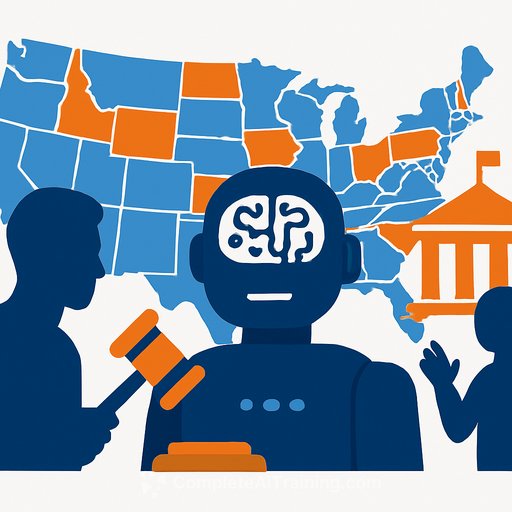
The United States is heading toward a decisive legal fight over AI control. The issue isn't whether AI needs guardrails-it's who sets them. Federal preemption advocates want a single playbook. States argue they're already on the field doing the work.
Why this turned into a legal battleground
With no comprehensive federal statute in place, states moved first. California's SB-53 (AI safety) and Texas's Responsible AI Governance Act (misuse prohibitions) are the headline examples, but they're part of a much bigger wave. The goal: curb concrete harms, set expectations for high-risk systems, and keep election integrity intact.
The federal push for supremacy
Industry wants one national standard, claiming 50 different regimes slow development and dull America's competitive edge. The federal posture has shifted accordingly, with three notable moves:
- Efforts to insert AI preemption into the National Defense Authorization Act
- Reports of a draft executive order supporting preemption of state AI laws
- Formation of an "AI Litigation Task Force" to challenge state statutes
The message is clear: consolidate AI governance at the federal level, or keep the field open and let market forces lead.
States: laboratories of democracy or innovation blockers?
As of November 2025, 38 states have enacted more than 100 AI-related laws. They cluster in a few practical areas:
- Deepfakes (42): Election integrity, impersonation, and personal protection
- Transparency (35): Disclosure and labeling for AI-generated content and systems
- Government AI use (28): Procurement, testing, record-keeping, and risk management
Supporters see states as fast, iterative problem-solvers. Critics see fragmentation that invites forum shopping and kills scale.
Where industry has planted its flag
Pro-AI groups have raised significant funds to resist state-by-state regimes and argue for self-governance. Their case: existing fraud, product liability, and consumer protection laws already cover misconduct, and extra layers slow progress. The tone from prominent backers is blunt-move fast, punish bad actors under current law, and avoid a compliance maze.
Congressional movement: a comprehensive package, with compromises
On Capitol Hill, a bipartisan House AI effort is assembling a broad bill. Core planks include:
- Fraud enforcement and penalties
- Healthcare AI standards
- Transparency requirements
- Child safety provisions
- Catastrophic risk testing and reporting
The proposal would require model testing with published results-formalizing what many labs do voluntarily. The political reality: any viable bill must pass across party lines and through a preemption fight.
The preemption debate in plain terms
More than 200 members of Congress and nearly 40 state attorneys general have pushed back on a federal block of state AI laws. Their position: states have to keep pace with harms as they emerge and can do so faster than Congress. New York's RAISE Act sponsor argues that trustworthy systems will win commercially-and measured rules make that possible.
What's actually at stake
Two points cut through the noise:
- AI firms already handle stricter regimes elsewhere, including the EU-so the "patchwork" burden may be overstated.
- Congress moves slowly. States act in one session. If preemption lands without strong federal standards, the result could be less accountability, not more clarity.
The outcome sets the template for liability, disclosures, testing obligations, and enforcement venue. That will shape risk, cost of capital, and go-to-market timelines for years.
Action plan for in-house counsel and law firms
- Track preemption vehicles: NDAA amendments, executive actions, and omnibus tech packages. Prepare comparison memos for clients by sector and state.
- Build a dual-track compliance plan: One path if federal preemption passes; one path if state regimes grow. Keep data sheets for deepfakes, transparency, and public-sector use.
- Contract hygiene: Add AI-specific reps, warranties, and indemnities (training data rights, safety testing, model updates, incident reporting, and content provenance).
- Testing documentation: Treat model evals like product safety files. Preserve logs, red-teaming results, and mitigations. Assume discovery.
- Election-year controls: Content labeling, impersonation safeguards, provenance metadata, and fast-takedown processes for synthetic media.
- Incident playbooks: Define thresholds for regulator notice, consumer communications, and model rollback. Rehearse cross-functional response.
- Align with recognized frameworks: Use NIST AI RMF as the baseline for risk management and audits.
Helpful reference points: the NIST AI Risk Management Framework and the EU's AI Act give a preview of mature compliance expectations.
FAQs
- Which state laws matter most right now? California's SB-53 (AI safety) and Texas's Responsible AI Governance Act (misuse prohibitions) headline a broader set of 100+ laws across 38 states focused on deepfakes, transparency, and government use.
- Who is pushing against state rules? Industry-backed groups argue for a single national standard and lighter-touch oversight to keep growth on track.
- What's in the federal package? Fraud penalties, healthcare standards, transparency, child safety, and catastrophic risk testing-plus a live fight over preemption.
- How does industry view governance? Many leaders prefer self-regulation backed by existing law (fraud, product liability), warning that layered state regimes create operational drag.
- Timeline risk? Even if a federal bill appears this term, rulemaking and implementation will take time. Expect states to keep filling gaps unless preemption lands.
Bottom line
This fight decides who writes the rules, who enforces them, and where companies face liability. If federal preemption arrives without strong standards, risk shifts to courts and private ordering. If states keep the pen, expect quick updates, uneven obligations, and faster enforcement.
For teams building internal AI literacy and compliance skills, see courses by job to accelerate policy, audit, and governance capabilities across functions.
Your membership also unlocks: