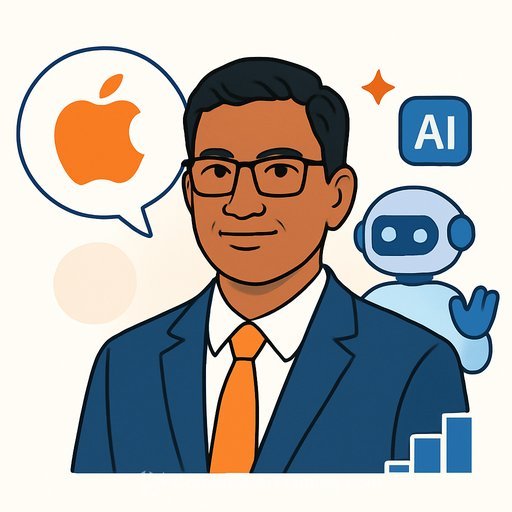
Who is Amar Subramanya? Apple's new AI chief
Apple is handing its AI reins to Amar Subramanya as John Giannandrea prepares to retire next spring after nearly eight years in the role. The timing matters: Apple is under pressure to speed up progress in generative AI and fix Siri's long-standing gaps.
Subramanya steps in as vice president of AI, reporting to Craig Federighi. He will lead teams working on foundation models, research, and AI safety - while parts of the previous AI remit move to Sabih Khan and Eddy Cue, signaling tighter integration across hardware, software, and services.
Why this move now
Giannandrea was brought in to reset Apple's AI approach and overhaul Siri. The results haven't landed fast enough, especially after the launch of ChatGPT in 2022 changed consumer expectations overnight.
Apple's own push, Apple Intelligence, has had a lukewarm reception so far. A major Siri upgrade - seen as the keystone for the company's AI product story - was pushed to 2026, raising questions about pace and execution.
Who Amar Subramanya is
Subramanya brings more than two decades in AI and machine learning. He served as a staff research scientist and principal engineer at Google, then as vice president of engineering for the Gemini model.
He briefly joined Microsoft in 2025 as corporate vice president of AI before moving to Apple. Inside Apple, he'll drive the core model roadmap, research agenda, and safety standards - and report directly to Federighi, who has been guiding the AI direction, including plans for a more personal Siri next year.
What this signals for Apple's AI strategy
Expect a stronger link between AI research and shipping software. Moving responsibilities to the COO and Services teams points to AI embedded across the stack: silicon, OS, and experiences.
The mandate for Subramanya is clear: accelerate progress on foundational models and translate that into user-facing outcomes, starting with Siri. If Apple can compress cycle times and align teams around a single model platform, the product story improves quickly.
Competitive context executives should note
Rivals aren't waiting. OpenAI set a new baseline, and Google continues to iterate at model and product layers. Apple's differentiation has to come from integration, privacy, and on-device performance - areas where it still has an advantage if execution tightens.
There's also pressure from outside incumbents. Former Apple designer Jony Ive and OpenAI's Sam Altman are progressing on AI-first hardware concepts, with prototypes reportedly complete and a launch window under two years.
Key watch items over the next 12 months
- Siri roadmap: concrete demos, partner ecosystem details, and timeline clarity for the 2026 upgrade.
- Model strategy: one core model with domain variants vs. multiple parallel bets - and how that shows up in iOS and services.
- Org velocity: evidence that splitting responsibilities to Khan and Cue improves delivery, not coordination cost.
- Developer support: SDKs, APIs, and guardrails that make Apple Intelligence useful beyond Apple's own apps.
- Privacy posture: on-device vs. cloud decisions and how Apple communicates the trade-offs to consumers and enterprises.
What this means for your strategy
- Reassess your assistant roadmap: plan for Siri upgrades changing user behavior across iPhone-heavy customer bases.
- Design for multi-model reality: support Apple's stack alongside OpenAI and Google to reduce platform risk.
- Scenario-plan hardware shifts: prepare product and channel strategies for AI-first devices that prioritize intent, context, and voice.
- Invest in AI safety and evaluation: Apple's emphasis here is a signal - governance and measurement will be a buying criterion.
- Upskill teams now: shorten the loop between research, prototyping, and shipping. Consider focused training for product, data, and ops.
Context and resources
For background on Apple's current AI push, see Apple Intelligence's overview page: apple.com/apple-intelligence. It outlines the feature set and early direction.
If you're building an AI capability roadmap for your org, explore role-specific learning paths here: Complete AI Training - Courses by Job.
Bottom line
Apple's AI leadership change isn't cosmetic. Amar Subramanya's remit is to speed up core model progress and translate it into products users feel daily.
If Apple hits its targets on Siri and model integration, it regains momentum. If not, the gap widens - and the market will adjust plans accordingly.
Your membership also unlocks: