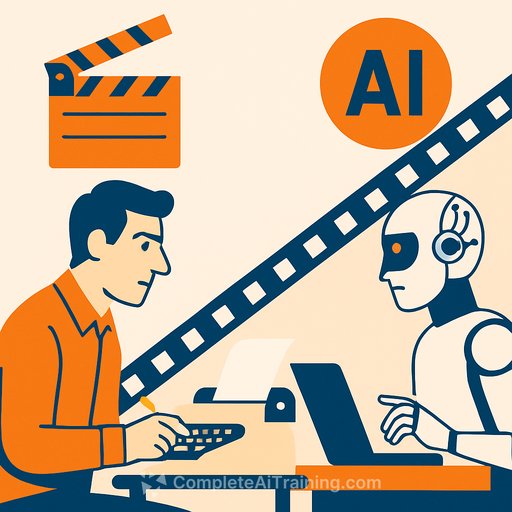
AI’s Growing Role in Hollywood and What It Means for Screenwriters
Since the launch of ChatGPT in late 2022, AI has quietly infiltrated Hollywood’s creative process. From script development to marketing, AI tools are increasingly present. Yet many screenwriters remain skeptical or outright resistant. Billy Ray, an Oscar-nominated writer known for films like Captain Phillips and The Hunger Games, has never used ChatGPT—not once.
Ray sees generative AI not as a helpful tool, but as a threat to storytelling and the writers themselves. He describes it as “a cancer masquerading as a profit center,” eroding the craft and the creative voice behind it. For writers who already wrestle with doubts and pressure, letting a machine write their scripts is out of the question.
Protecting Writers’ Creative Rights Amid AI Advances
The 2023 Writers Guild strike resulted in important contract language addressing AI. Studios cannot force writers to use AI, and AI-generated content isn’t considered original literary material. Writers may use AI only with approval and under strict rules protecting credit and ownership.
However, many feel these measures aren’t enough. AI tools are evolving fast, and studios are quietly exploring ways to incorporate them, potentially cutting writers’ roles and shrinking teams. The result could be a flood of mediocre content and fewer jobs for writers.
According to the Writers Guild’s 2024 financial data, fewer members are earning income, dropping nearly 10% from the previous year and over 24% since 2022.
For screenwriters, this signals an urgent need for stronger protections. Billy Ray urges the union to act swiftly to establish clear boundaries before future contract talks.
The Creative Limits of AI Writing
AI models like ChatGPT stitch together text based on patterns in massive datasets, but they lack true understanding of plot, character motivation, or emotional depth. They can create plausible scenes but don’t grasp the meaning behind them or how to evoke lasting feelings.
This limitation is critical. Storytelling is about connecting with human experience, something AI cannot replicate. While formulas and beat sheets have long guided screenwriting, AI attempts to take over the creative act itself, raising the question: what happens when stories are shaped by systems that do not feel?
Writer-director Todd Haynes emphasizes that creativity emerges from imperfection, desire, and unpredictability—qualities AI cannot mimic.
AI and the Writers: Different Views and Experiments
The industry’s response to AI is mixed. Some see opportunity in using AI to handle mundane tasks like writing loglines or treatments. Amit Gupta, co-founder of the AI writing tool Sudowrite, highlights how AI can streamline these parts without replacing the writer’s vision.
Others, like Paul Schrader, have embraced AI more wholeheartedly, praising it as a source of quick and original ideas. Schrader even compares AI’s capabilities to a historic moment in chess when a machine surpassed a human champion.
But not everyone agrees. Billy Ray questions the value of this approach, while Bong Joon Ho, acclaimed for films like Parasite, doubts AI can deliver stories with true depth or irony.
Emerging voices like Roma Murphy, co-chair of the Animation Guild’s AI Committee, warn that AI-generated scripts often feel hollow and lack new truths. They see AI as a cheap trick rather than a genuine creative partner.
Film Schools and the AI Debate
Film schools are grappling with when and how to introduce AI to students. USC’s School of Cinematic Arts offers classes on AI’s role in media but intentionally keeps screenwriting separate. The focus is on protecting the early creative phase where writers develop their unique voice without relying on technology.
This approach acknowledges that while understanding AI is important, the vulnerable moment of creation should remain human-driven.
AI in Practice: Early Experiments and Cautionary Notes
British filmmaker Oscar Sharp experimented with AI-generated scripts nearly a decade ago. His shorts, like Sunspring, demonstrated AI’s ability to mimic genre patterns but also revealed its limitations: repetitive loops and nonsensical narratives.
Sharp uses AI occasionally as a creative foil, pushing against its suggestions rather than outsourcing work. He warns that if AI prioritizes profit, it risks producing formulaic content that lacks soul—what he calls “McDonald’s” storytelling, rather than the truth people crave.
What Screenwriters Need to Know
- AI is becoming part of Hollywood’s toolbox but threatens to disrupt traditional writing roles.
- Writers currently have protections, but these need strengthening as AI tools advance.
- AI cannot replace human creativity, emotional insight, or the unique voice that connects with audiences.
- Using AI for routine tasks can free writers to focus on deeper storytelling, but relying on it too heavily risks creative dilution.
- Understanding AI's capabilities and limits is essential for writers who want to maintain control over their craft.
For screenwriters looking to stay informed and adapt thoughtfully, exploring AI tools with caution and clarity is key. Check out trusted resources and courses that help writers understand AI’s role without sacrificing their creative integrity, such as Complete AI Training’s courses for writers.
As AI continues to spread across the industry, the core question remains: who holds the pen, and what stories will they tell?
Your membership also unlocks: