The Urgency of AI Education
Artificial intelligence is reshaping the intellectual, emotional, and economic foundations of society. A quick look at mainstream and social media reveals a future that will be very different from the past. Technological disruption is nothing new—history shows us that transformative technologies trigger societal shifts and national urgency. Today, that technology is AI.
Recently, the White House issued an executive order (EO) focused on AI education, reflecting concerns about China’s rapid progress. This EO, though possibly overlooked amid many others, marks a critical moment. Its mission is to provide opportunities that cultivate the skills and knowledge needed to develop the next generation of AI technology.
Key Priorities in the Executive Order
- Introduce AI to students at an early age.
- Train teachers to effectively integrate AI into their classrooms.
- Promote AI literacy to build a workforce ready for AI-driven industries.
These steps are necessary, especially since AI exposes gaps in our education system, particularly in STEM (science, technology, engineering, and mathematics). However, the EO misses critical elements essential to a well-rounded AI education.
Beyond Technical Skills: The Need for Critical Thinking and Ethics
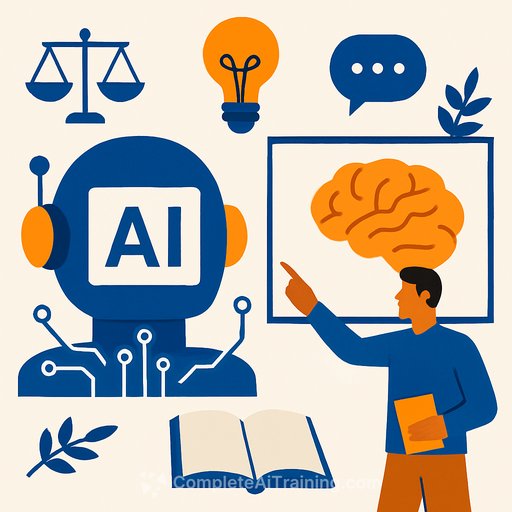
You cannot teach AI without teaching critical thinking, ethics, and judgment. The national conversation must go beyond simple technical training. As AI becomes part of every aspect of life, we face a choice: Do we become passive users of knowledge, or do we actively develop wisdom?
Technical skills alone risk turning people into mere replicas of AI—capable but unreflective. Instead, education should foster critical thinking, ethical reasoning, and curiosity. The goal is not just to learn how AI works but to understand how to live responsibly in a world shaped by AI.
Tech optimism needs to be balanced with serious intellectual and moral inquiry. Without this balance, concerns from skeptics and critics may prove valid.
Looking Ahead: What Should AI Education Include?
While the EO is a starting point, it does not fully address the relationship between humans and AI. Future policies should confront AI’s risks and clarify how education and society should respond both practically and philosophically.
An ideal AI curriculum would include:
- Philosophical insights on how technology shapes human experience, such as those from Martin Heidegger.
- Thought experiments like Nick Bostrom’s “paper clip” scenario, illustrating AI’s possible unintended consequences.
- Critiques of modern technology’s impact on society, including surveillance capitalism as discussed by Shoshana Zuboff.
AI will soon be everywhere and intuitive to use, much like how the mouse and web browser became universal in the 1990s. Instead of focusing on current AI tools, education should teach how technology evolves and affects society over time.
As computer scientist Alan Kay said, “Technology is anything that was invented after you were born.” Staying competitive globally requires more than technical skills; it demands a cultural vision.
Global Leadership and the Role of Wisdom
Past moments of urgency—like Sputnik or concerns about Japan’s technological rise—have shaped America’s approach to innovation. Today, that concern centers on China’s AI advancements. But the real question is which country will use AI to build a better society.
French philosopher Alexis de Tocqueville once said, “America is great because it is good. If America ceases to be good, America will cease to be great.” This wisdom is crucial as we consider AI’s future.
Leading in AI will require prioritizing wisdom over raw intelligence. True greatness won’t come from executive orders alone but from strong social foundations that emphasize ethical and thoughtful use of technology.
For educators, this means pushing beyond coding and algorithms to develop thoughtful citizens ready to engage with AI’s implications on society. To explore practical AI courses and resources for educators, visit Complete AI Training.
Your membership also unlocks: