Embracing AI in Education: A New Mindset
Large language models (LLMs) are processing information faster than ever, crossing traditional disciplinary boundaries and challenging higher education to rethink teaching, learning, and academic structures. As AI tools disrupt familiar frameworks, educators are split between banning these technologies or embracing them in classrooms. Both approaches risk overlooking a deeper shift that Marshall McLuhan predicted over 60 years ago: automation does not make the liberal arts obsolete—it makes them essential.
‘Oracle of the Electric Age’
In the 1960s, Canadian communication theorist Marshall McLuhan, known as the “oracle of the electric age,” published Understanding Media. In the chapter “Automation: Learning a Living,” he observed, “Little Red Schoolhouse Dies When Good Road Built.” Technological change, McLuhan argued, transforms systems rather than simply adding to them. Where roads once expanded access to specialized education, automation dissolves disciplinary walls and redefines learning and work.
He wrote: “Automation … not only ends jobs in the world of work, it ends subjects in the world of learning.” McLuhan foresaw that computing would enable new pattern recognition methods, requiring integrative, relational, and responsive thinking instead of merely speeding up old techniques.
Automation Makes the Arts Mandatory
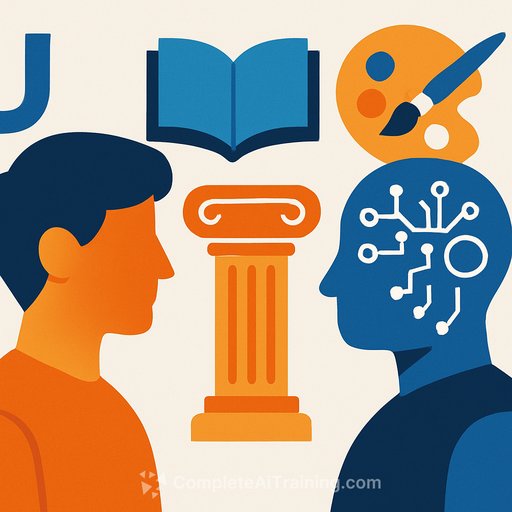
Contrary to fears that automation would sideline the humanities, McLuhan claimed it actually makes them mandatory. As machine intelligence becomes part of communication and creativity, humanities—focused on cultural insight, ethical reasoning, and imagination—become crucial. This connects to the concept of the “adjacent possible,” introduced by Stuart Kauffman and popularized by Steven Johnson, which describes the new opportunities unlocked when existing ideas and technologies combine in fresh ways.
From this emerges what can be called AI-adjacency: a mindset that views artificial intelligence not as a replacement for human intellect but as a partner for strategic collaboration and creative inquiry.
6 Ways AI Can Be a Partner in Creative Inquiry
- Critical Discernment
Effective AI use begins with the ability to evaluate intellectual and cultural value beyond whether AI was involved. The controversy over Jason Allen’s AI-assisted image Théâtre D'opéra Spatial highlights this. Allen spent over 80 hours crafting 600+ text prompts and digitally editing the piece. This debate shows that discernment must go beyond detecting AI use to examining authorship, effort, and aesthetic merit. - Strategic Collaboration
Knowing when and how to involve AI tools is key. A study found that ChatGPT positively impacted students’ writing skills. One student noted that using ChatGPT in a classroom setting sparked meaningful conversations and collaborative writing. The value lies in AI-facilitated teamwork that encourages deeper engagement with expression and learning. - Voice and Vision Stewardship
Technology should serve individual creativity. At Berklee College of Music, students explore AI’s potential but must ensure outputs reflect their own style, not just AI fluency. This approach nurtures self-awareness and ownership of creative work despite technological collaboration. - Cultural and Social Responsibility
AI tools carry biases but can amplify marginalized voices if developed responsibly. On Vancouver Island, AI voice-to-text technology is being created for Kwak'wala, an endangered Indigenous language. This tool, built from scratch due to the language’s verb-centered structure, helps communities reclaim linguistic heritage. Crucially, Indigenous groups lead development, preserving cultural knowledge. - Adaptive Expertise
Adaptive expertise involves knowing when to innovate beyond routine solutions. In medical education, this means applying standard procedures when appropriate but shifting to creative problem-solving as needed. History students, for example, might use AI to analyze archival data but must also interpret cultural significance through innovative, human-driven analysis grounded in liberal arts. - Creative and Intellectual Agency
Rooted in the concept of Bildung—developing oneself through critical engagement—this principle remains essential in an AI-integrated environment. Higher education must find ways to amplify independent thinking while collaborating with AI. For instance, at Lehigh University, humanities students team with computer scientists to create courses like “Algorithms and Social Justice,” blending humanistic perspectives with data analysis.
McLuhan’s Warning: Loss of Self-Awareness
McLuhan’s interpretation of the Narcissus myth offers a caution. Narcissus didn’t fall in love with himself but mistook his reflection for another. This “extension of himself by mirror” numbed his perceptions until he became a servant to his own image. The real risk with AI is not replacement but losing self-awareness.
If we passively accept AI as an extension of ourselves without critical engagement, we risk allowing these tools to shape our thinking, creativity, and learning unconsciously. In McLuhan’s terms, we become tools of our tools. Adopting AI-adjacent practices through the six dimensions outlined provides a way to retain agency and use AI critically and creatively.
For those interested in deepening their understanding of AI's impact and collaboration strategies, relevant courses are available at Complete AI Training.
Your membership also unlocks: