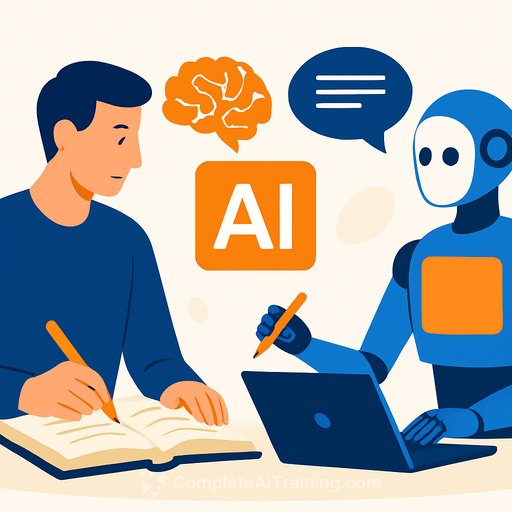
Writers vs AI: the uncomfortable truth
In a very short span, a new belief has set in: fiction authors are on borrowed time. A recent Cambridge study of 258 published novelists and 74 industry figures found that more than half think AI will entirely replace their work, with romance, thriller, and crime writers feeling most exposed.
This isn't just about the big apps. Tools built for long-form output now exist end to end: Sudowrite and Novelcrafter for ideation and edits, Qyx AI Book Creator and Squibler for drafting, and Spines for layout and publishing. Decades ago, 1984 imagined writing machines. We're here.
Why the threat is real
People buy formulas. Safe tropes. Predictable arcs. A lot of what fills feeds, catalogues, and catalog copy can be described as filler: "content" that hits the word count and moves on.
Entire campaigns are built to be unremarkable on purpose. If "OK" is the bar, AI clears it all day for free. That's the real risk to working writers who earn by producing passable output on schedule.
What AI still can't do (and where you win)
AI can remix. It can't want. It won't stumble on an idea in the shower and chase it like its life depends on it. Even with more capable systems, you get confident mimicry, not desire, not stakes.
- Taste: choosing one bold cut over ten safe options
- Lived tension: real risk, shame, awe, loss, and how it changes a person
- Voice: rhythm, timing, and subtext that grows across books, not prompts
- Synthesis: connecting fields and eras in ways a dataset wouldn't guess
- Improvisation: holding a room live, taking questions, and rewriting on the fly
The sludge trap: don't compete at "OK"
An academic friend summed up AI's effect on student essays: almost everything is now "fine," nothing is great, and nothing is awful. The edges disappeared. That's the zone AI loves.
If your work reads like a template, you're replaceable. Your edge is depth, specificity, and moves an algorithm won't risk.
A practical playbook for working writers
Positioning: be precise or be invisible
- Pick a reader outcome you obsess over (catharsis, clarity, courage, escape)
- Own a specific promise, not a generic genre ("hopeful sci-fi about aging," "cosy crime with neurodivergent MCs")
- Define your non-negotiables: themes, moral lines, tone, pacing
- Build a micro-audience that will buy anything you write because it's you
Process: human-first, AI-assisted
- Research: use AI to gather references and contradictions; you decide what matters
- Outlining: have it generate structure variants and beat options; you merge and cut
- Drafting: write openings, turns, and endings yourself; those carry the soul
- Line work: run passes for cliché hunting, continuity, and punchier verbs; edit by hand
- Style guardrails: keep a short document of tone, taboos, and signature moves; paste it into any prompt
- Fact-check everything; never ship AI text unedited
Proof of work: show you're human
- Host live readings and Q&A; record and publish the audio
- Share marginalia: why you made a choice, what you cut, and what it cost
- Serialize chapters and gather notes from your core readers before print
- Offer annotated editions and behind-the-scenes sessions as paid perks
Product and packaging: sell the experience
- Release premium print with tactile design, maps, sketches, and author notes
- Produce an audiobook in your voice; add a director's commentary track
- Bundle short stories, essays, and deleted scenes as subscribers' extras
Contracts and IP: protect the work
- Add clauses restricting synthetic training on your text where possible
- Register copyrights and track piracy hot spots
- Ask publishers how they use AI across edits, covers, and marketing
Metrics that matter
- Depth over reach: completion rate, re-reads, direct replies, and saves
- Direct audience: email list size and response, not just followers
- Preorders and repeat buyers as your main signal of health
30-day plan to build an AI-proof edge
- Week 1: Define reader outcome, write a one-page style guide, and a one-sentence promise for your next book
- Week 2: Create three outlines (yours + two AI variants); merge into one strong structure
- Week 3: Draft 15,000 words focusing on voice and turns; use AI only for research and cliché sweeps
- Week 4: Run a live reading, collect notes, and revise one act end-to-end
Watch the fake-book gold rush
You've seen the pitch: "Crank out a PDF on anything, sell by midnight, cash by Friday." It's a short con. Don't let your name swim in that pool.
Build work that's traceable to a person with standards. That's how you get invited back, paid well, and hard to copy.
The next chapter: maybe we go oral again
Some universities are pushing more viva voce exams because typed work blends into one voice. That points to a path for writers, too.
Lean into unscripted formats: live rooms, small salons, podcasts with readings. The more you prove there's a human behind the words, the safer your lane.
Use AI. Don't be used by it.
AI will eat average. Let it. Your job is to write the pages a machine wouldn't dare to propose, then prove you can stand behind them in public.
If you want practical tooling without losing your voice, here are curated options for writers and content pros: AI tools for copywriting and role-specific paths at Courses by job.
Your membership also unlocks: