In an AI World, Catholic Education Is More Important Than Ever
Artificial intelligence is reshaping jobs and daily life, with experts predicting that up to half of white-collar jobs could disappear within the next decade. This shift poses unique challenges for education, especially in how students learn and develop both academically and morally.
As AI tools like ChatGPT make traditional assessments, such as formulaic essays, quick and easy to complete, the real impact goes deeper. AI is altering how young people think, form beliefs, and engage with history and culture. Social media algorithms powered by AI further complicate this by influencing children's worldviews and social connections, often in harmful ways.
Challenges Facing Catholic Schools
Catholic education now confronts risks such as superficial academic achievement, moral uncertainty, weakened family bonds, secular biases, and a decline in spiritual depth. These issues echo past societal upheavals where rapid changes left many children vulnerable.
For example, the Industrial Revolution brought technological progress but also fractured families and exploited children. Similarly, the French Revolution attempted political progress but disrupted family structures and imposed ideologies that devalued childhood, resulting in social unrest and nihilism.
Today, many young people feel disconnected from their families and are vulnerable to divisive ideologies centered on identity politics. This contributes to youth gang formation and exposure to harmful behaviors. Schools frequently experience a breakdown in moral foundations, resulting in increased misbehavior and a shift toward relativistic social values rather than virtue and meaning.
The Limits of Current Educational Approaches
Attempts to address behavioral issues in schools often lean heavily on pragmatic psychology and “wellbeing” programs. However, these approaches can lack depth and fail to provide students with a solid moral compass. In the absence of objective morality and strong family support, forming peer groups or “gangs” can feel more rewarding than participating in activities that lack spiritual significance.
Learning from History
History offers guidance. After the Industrial Revolution, authors like Charles Dickens and William Blake used faith-inspired storytelling to highlight the spiritual neglect of children. The Church responded through leaders like Pope Leo XIII, who championed workers’ rights and the importance of education over exploitation in Rerum Novarum.
Saints such as John Vianney, Jean Baptiste De La Salle, and Madeleine Sophie Barat provided moral formation and healing after the French Revolution’s violence—not through ideology, but through authentic spiritual guidance.
The Church’s Role Today
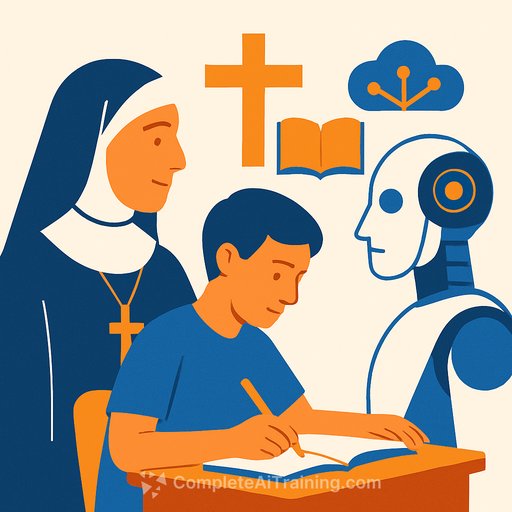
Today, the Church must respond to the AI transformation by ensuring its schools remain places of true formation. This means resisting pressure to conform education to economic demands or ideological trends. Instead, educators should focus on challenging students with classical literature that centers on human dignity, such as works by Dickens, Blake, the Brontës, or Dante.
As AI renders mechanical measures of education less relevant, the demand for genuine human formation grows. A rich theological and philosophical foundation can replace superficial psychological approaches, just as Pope Leo XIII provided moral clarity during past upheavals.
Our current pope, who also bears the name Leo, signals an intention to offer guidance amid global uncertainty. Catholic schools should aim higher than fleeting notions of wellbeing and commit to forming saints—following the examples of teacher saints like St Jean-Baptiste De La Salle and St Don Bosco.
Remembering the Dignity of Childhood
The greatest modern promoter of childhood dignity is a saint: St Nicholas. His legacy and the celebration of Christmas remind us of the profound truth of God becoming a child. Yet, this truth coexists with threats, symbolized by King Herod’s attempt to create an artificial kingdom based on earthly power.
Educators must never forget the Imago Dei—the image of God—in every student, nor the dangers posed by artificial systems that seek to replace authentic human development with shallow imitations of community and meaning.
In this time of AI-driven change, Catholic education offers a vital path forward. It provides not just knowledge, but the moral and spiritual grounding necessary to navigate a world where technology changes fast but human dignity remains constant.
Your membership also unlocks: