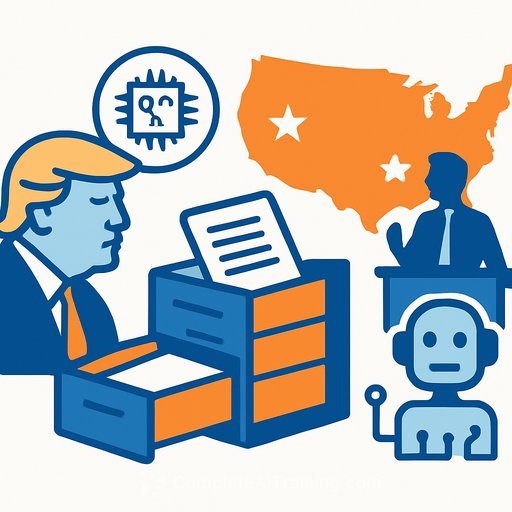
Why Democratic Governors Are Quiet on Trump's AI Preemption Order - And What State Officials Should Do Now
Voters across parties want stronger guardrails on AI. Yet many Democratic governors have been quiet after President Donald Trump signed an executive order telling the federal government to block state-level AI rules.
That silence came days after a reported closed-door gathering at the Democratic Governors Association meeting in Phoenix, where lobbyists for firms including OpenAI and Meta met with governors such as Gavin Newsom (CA), Gretchen Whitmer (MI), Andy Beshear (KY), and Wes Moore (MD). The timing raised questions inside policy circles about industry influence and 2028 ambitions.
What the executive order does
The order directs the Department of Justice to set up an AI Litigation Task Force. Its mission: sue states over "onerous and excessive" AI rules and threaten federal funding for states that press ahead anyway.
For state and local agencies, this sets up a preemption fight with immediate operational consequences. Expect rapid coordination between DOJ and agency general counsels on where state policy lines are drawn.
Why the silence?
According to reporting from Sludge, tech lobbyists had unusual access at the DGA meeting. Several Democratic governors rumored for national bids were in the room. At the same time, congressional Democrats have built closer ties with the AI sector through donations and investments, even as some - like Rep. Alexandria Ocasio-Cortez - push for stronger rules.
Political calculus is part of it. Industry wants uniform federal standards; governors want flexibility without a fight with DOJ or donors. The result: caution in public, negotiations in private.
Contrast with Republican governors
Republican governors have been louder on states' rights. Seventeen GOP governors warned congressional leaders against preempting state AI policies back in June, and Utah's Spencer Cox, Florida's Ron DeSantis, and Arkansas's Sarah Huckabee Sanders have criticized the order.
That leaves an unusual split: Republicans defending state authority on AI, Democrats weighing federal uniformity against public demand for tougher rules.
Implications for state and local government
Agencies face a near-term compliance problem. Pending or recently enacted AI laws (procurement, hiring, education, law enforcement, consumer protection) may be targeted by DOJ. Even guidance documents could be scrutinized if they function like rules.
Procurement, risk, and civil rights teams should prepare for litigation holds, policy reviews, and narrower implementation that still advances safety and equity goals inside the limits of the order.
NCSL tracker: State AI legislation
What to do now (practical steps for government professionals)
- Inventory: Map every AI-related statute, rule, executive memo, and procurement clause across your enterprise. Flag items that impose obligations on vendors, agencies, or public users.
- Triage: Separate high-risk items (mandates, enforcement, penalties) from lower-risk items (voluntary standards, internal controls, pilots).
- Legal posture: Work with your AG to prepare preemption analyses, Spending Clause risk reviews, and potential stays if DOJ files or threatens action.
- Shift to policy-by-contract: Where feasible, move requirements into procurement language and service-level agreements to maintain safeguards without promulgating new rules.
- Adopt recognized frameworks: Use federal-aligned references (e.g., NIST AI RMF) in guidance and contracts to reduce preemption risk while keeping safety practices in place.
- Document harms: Build a record of concrete risks (bias in hiring, misinformation in public services, data leakage) and the measured controls you use to address them.
- Coordinate regionally: Align with neighboring states and associations to share model language and defense strategies. A unified posture deters selective enforcement.
- Public communication: Keep constituents informed that internal safeguards continue even as litigation unfolds. Emphasize service quality, fairness, and security.
What to watch next
DOJ's first enforcement picks will signal whether the focus is on labor, education, consumer protections, or law enforcement tech. Watch for multi-state litigation and requests for preliminary injunctions.
Congress may pursue a federal standard. If that happens, the details on state carve-outs and enforcement will matter more than the headline.
Bottom line
Politics aside, agencies still need practical AI risk controls. Tighten your internal governance, move safeguards into contracts where possible, and prepare your legal case for why measured state action serves residents without conflicting with federal authority.
If your team needs to build AI literacy for policy, procurement, or oversight, see our curated programs by role: Complete AI Training: Courses by Job
Your membership also unlocks: