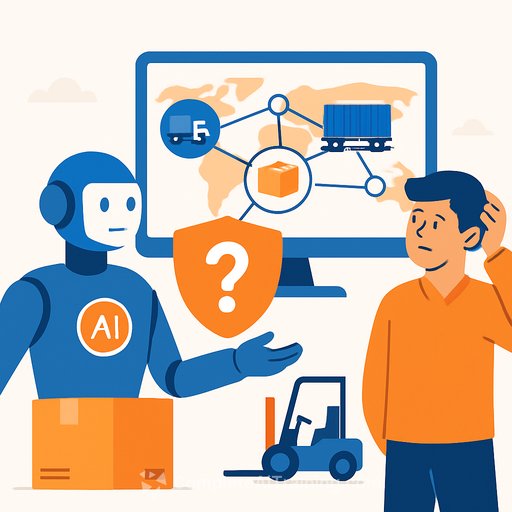
Can We Fully Trust AI in Supply Chain Management?
Artificial intelligence is changing how supply chains operate by providing real-time insights and predictive analytics. But is it realistic to place full trust in AI systems? Industry experts weigh in on the benefits, risks, and the essential role of human oversight in making AI a dependable partner in logistics.
AI Is a Tool, Not a Replacement
AI excels at tasks like inventory management, sorting, and forecasting. However, it always requires guardrails. Human oversight ensures AI decisions align with company goals and can intervene in complex situations through manual overrides.
Trust in AI should not be blind. It is crucial to evaluate AI outputs based on confidence levels, which vary depending on the task. For example, a 95% confidence level might be acceptable for route optimization but insufficient for sensitive operations.
Visibility and Data-Driven Decision Making
By 2028, AI agents are projected to power a quarter of supply chain KPI reporting. When combined with process intelligence, AI enhances visibility and provides trustworthy data that supports better decision-making.
While AI has proven valuable in supply planning, transportation optimization, and factory scheduling, the full potential of AI in supply chain management remains largely untapped. New use cases require ongoing exploration and testing before organizations can place full reliance on AI.
The Case for a Hybrid Approach
AI models depend heavily on the quality of their training data and require continuous refinement. The most effective approach blends AI with human expertise. This ensures efficiency and innovation driven by AI are balanced with human judgment to handle nuances and unforeseen challenges.
Trust in AI builds gradually, fueled by transparency, accountability, and continuous improvement. Successful partnerships between humans and AI rely on earned confidence through consistent, positive outcomes such as avoiding overstocking and meeting delivery deadlines.
“Trust But Verify” — AI as a Co-Pilot
AI should be viewed as a co-pilot, enhancing human decision-making rather than replacing it. Prioritizing explainable and auditable AI models is essential to maintain transparency and accountability. Humans must remain involved, particularly for strategic or ethical decisions.
Absolute trust in AI is difficult to achieve, as with any information source or transaction. Maintaining knowledge of the supply chain and implementing verification methods continue to be vital. Human oversight and continuous evaluation remain key to mitigating risks such as data bias and system errors.
Don’t Hand Over the Keys
AI’s role in supply chain management is to complement human insight, not to operate independently. Quality data and domain expertise are prerequisites for smart AI integration. The goal is informed reliance, not blind faith.
AI can identify patterns, suggest actions, and flag potential problems, empowering human experts to make final decisions. Trust is maintained when mistakes are acknowledged and addressed—something AI itself cannot do since it lacks accountability.
Algorithms bring efficiency and reduce human error, but they cannot replace critical thinking, experience, or the human touch essential for customer trust and relationship management.
Why Full Trust in AI Remains a Challenge
- AI depends on data quality and can inherit biases or errors.
- Complex, real-time decisions still require human judgment.
- AI lacks the ability to apply ethics, context, and creativity.
- Complete automation without oversight could lead to significant risks.
Human involvement ensures that judgment, context, and ethical considerations remain part of supply chain operations. The most effective systems pair AI capabilities with human review and intervention.
Proceed With Caution
AI is only as good as the data it processes and the people who train it. Garbage in, garbage out remains true in the AI era. Strong data governance and experienced teams are essential for AI to be worthwhile.
Like any tool, AI can amplify both strengths and weaknesses. Supply chain leaders need to continuously audit AI outputs and demand transparency from AI developers. Real leadership keeps human judgment in the driver's seat while leveraging AI for efficiency.
The Future of Trust in AI
Trust in AI grows through demonstrated results and system maturity. As AI models improve and operate on diverse, high-quality data, their reliability increases. However, full autonomy is still a distant milestone.
AI is best positioned as a powerful assistant that accelerates decision-making, uncovers hidden patterns, and reduces inefficiencies, while humans provide oversight, ethical guidance, and contextual understanding.
Organizations that combine intelligent automation with human insight will be the ones to benefit most. For managers aiming to stay ahead, investing in AI training and human-AI collaboration strategies is critical. Explore comprehensive AI courses and resources to strengthen your team’s capabilities at Complete AI Training.
Key Takeaways for Management
- AI can improve supply chain efficiency but requires human supervision.
- Trust is earned through consistent, transparent, and explainable AI outcomes.
- Hybrid models combining AI and human expertise deliver the best results.
- Invest in quality data and ongoing AI training for your teams.
- Maintain verification processes to mitigate risks like bias and errors.
AI will not replace humans in supply chain management, but humans working with AI will outperform those without it. The path forward is smart integration, not blind reliance.
Your membership also unlocks: