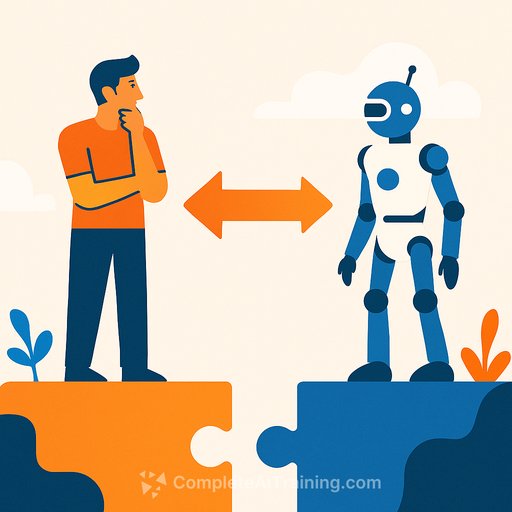
Humans Adapt. Machines Struggle. The Missing Link: How We Generalize
Humans learn concepts and carry them into new situations. Most AI systems learn patterns and hope those patterns still apply. An interdisciplinary team led by researchers at Bielefeld University argues the gap comes down to different meanings of "generalization" across cognitive science and AI-plus how we test it.
"Machines generalize differently than humans and this is crucial for the success of future human-AI collaboration," says Barbara Hammer, who co-authored the paper in Nature Machine Intelligence with colleagues including Benjamin Paaßen.
What "generalization" means across fields
- Cognitive science: abstraction, concept formation, and transferring principles across contexts.
- Machine learning: performance beyond the training distribution (out-of-domain), robustness, and transfer.
- Symbolic AI: rule-based inference and logical deduction.
- Neuro-symbolic AI: combining learned representations with logic for structure and abstraction.
How humans vs. machines generalize
- Humans: build concepts, compress details into meaning, and flexibly reapply them.
- AI systems: rely on statistics, heuristics, or rules tuned to domains; strong within scope, brittle outside it.
- Evaluation gap: people are judged on adaptability; machines are often judged on held-out accuracy-sometimes on the same distribution.
A shared framework (three dimensions)
- Notion: specify the kind of generalization targeted (conceptual transfer, out-of-domain, rule application, or hybrid).
- Method: document the mechanism (abstraction, inductive bias, causal structure, rules, or neuro-symbolic fusion).
- Evaluation: test with protocols that reflect the notion-e.g., systematic generalization, counterfactuals, causal interventions, and human-centered tasks.
Why this matters for human-AI teams
Medicine, transportation, and public decisions demand systems that deal well with the unknown. If researchers align the notion, method, and evaluation of generalization with human reasoning, AI can better support human values, expectations, and decision logic.
Practical takeaways for researchers and R&D teams
- State the exact generalization target up front; avoid vague claims.
- Choose methods that encode structure (causal models, compositionality, constraints) instead of only scaling data.
- Evaluate outside the comfort zone: distribution shift, compositional tests, and counterfactual probes.
- Leverage neuro-symbolic approaches when task rules and abstractions are known.
- Measure human compatibility: can domain experts predict model behavior and rationale?
- Build datasets and benchmarks that reflect human concept use, not just label frequency.
Who is behind the work
The paper brings together more than 20 experts from institutions including Bielefeld, Bamberg, Amsterdam, and Oxford. It grew out of a workshop at Schloss Dagstuhl and contributes to the SAIL project on sustainable, transparent, human-centered AI, funded by the Ministry of Culture and Science of the State of North Rhine-Westphalia.
Further reading
- Nature Machine Intelligence - journal hosting the study.
Skill-building
- For teams working on evaluation, causal reasoning, and neuro-symbolic methods, explore curated AI courses by role: Complete AI Training: Courses by Job.
Key facts at a glance
- "Generalization" has different meanings in cognitive science and AI.
- Humans generalize via abstraction and concepts; AI often uses domain-specific statistics or rules.
- A shared framework-what it means, how it's achieved, how it's evaluated-can help build AI that fits human reasoning.
- Source: Bielefeld University; project: SAIL.
Your membership also unlocks: