
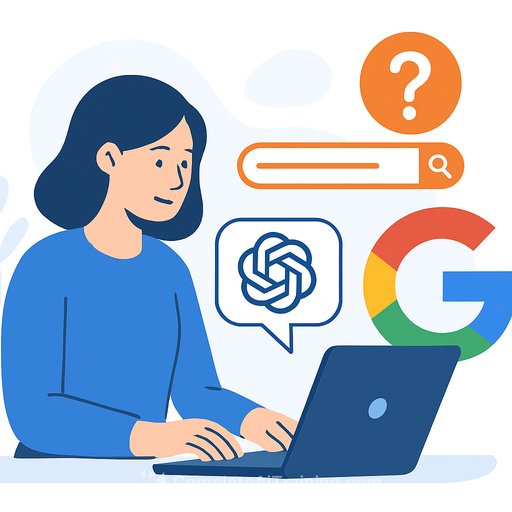
The ChatGPT Effect: How We Look Things Up Has Quietly Changed
Three years ago, most people typed a question into Google, searched YouTube, or asked a smart speaker. Today, a huge share opens ChatGPT and just asks.
This isn't a fad. It's a shift in habit. ChatGPT has become the new front door to information for everyday questions, quick explanations, and "what does this mean?" moments.
What actually changed
Within months of its 2022 launch, ChatGPT hit 100 million weekly users. By late 2025, usage reached roughly 800 million weekly users. That puts it among the most used consumer apps on the planet.
Surveys show behavior moved with it. A 2025 Pew study reports 34% of U.S. adults have used ChatGPT, with 58% of adults under 30 trying it. An AP-NORC poll found about 60% of U.S. adults who use AI rely on it to search for information; that jumps to 74% for under 30.
Search isn't gone - it's reordered
People haven't stopped "Googling." They've changed which tool they start with. ChatGPT now handles the quick, clarifying questions where a plain-English answer beats a page of links.
Google has adjusted. AI-generated "Overviews" now sit on top of results and answer common questions instantly. That contributes to a surge in "zero-click" searches. One analysis using Similarweb data shows Google-to-news traffic dropping from 2.3B+ visits in mid-2024 to under 1.7B in May 2025, while the share of news-related searches ending with zero clicks jumped from 56% to 69% in a year.
ChatGPT vs. Google: strengths and trade-offs
- ChatGPT: Fast, conversational explanations. Great for summaries, definitions, drafts, and tone-polishing. Accuracy improves with clear prompts. Source transparency can be thin unless you ask for it.
- Google: Best for comparing multiple sources and perspectives. Ideal for deep research, news, and original sources. Results can feel cluttered and optimized for clicks.
OpenAI is also nudging people to make ChatGPT their default by promoting browsers with ChatGPT built in.
Smart speakers and YouTube: different roles now
Smart speaker ownership is steady to slightly down (about 34% of people 12+ in 2025 vs. 35% in 2023). Short answers are fine, but for a plan, draft, or deeper explanation, many people go to ChatGPT first.
YouTube remains massive (about 2.74B users as of 2024) and dominant among U.S. teens (roughly 90% use it). The pattern: ask ChatGPT for the overview or checklist, then go to YouTube only if you need to watch the physical steps.
Specialized forums feel the shift
Developer Q&A sites, like Stack Overflow, saw question volume fall after ChatGPT launched. Some analyses estimate traffic declined ~50% from 2022 to 2024. If a chatbot can generate a code snippet and explanation on demand, fewer people post publicly.
How to pick the right tool fast
- Start with ChatGPT for definitions, summaries, email drafts, checklists, policy explanations, and "what should I say?" moments.
- Use Google for news, source-checking, statistics, product comparisons, and anything with meaningful stakes.
- Jump to YouTube when you need to see a task done (repairs, tutorials, visual workflows).
- Smart speakers are best for quick facts, timers, and hands-free control - not detailed guidance.
A quick prompt that gets better answers
- Goal: "Explain X in plain English for a non-expert."
- Context: "I work in [role/industry]. The decision is [A vs. B]."
- Constraints: "3 bullet options, 2 pros/cons each, keep it under 150 words."
- Verification: "List sources or what I should double-check."
Trust, but verify
- For anything important, cross-check with at least two credible sources.
- Ask ChatGPT: "Cite sources" or "What might be wrong or outdated here?"
- Use Google to confirm stats, quotes, and policy details.
What this means for your workday
ChatGPT didn't replace your tools. It reordered them. Many people now start with a chat, then branch out as needed.
That small shift saves time. You get clarity first, then you choose whether to search, watch, or scroll. Less friction. Fewer tabs. Better outcomes.
Fast workflows you can steal
- Inbox replies: Paste the awkward email → "Suggest a polite response in 3 tones: firm, friendly, neutral."
- Policy clarity: "Summarize this benefits policy in 5 bullets. What decisions do I need to make?"
- Project kickoff: "Give me a 7-step plan, owners, and risks for launching [project]."
- Learning a topic: "Explain [topic] at a high level, then suggest a 30-minute study plan."
Sources and further reading
Level up your AI skills
Want proven ways to use ChatGPT at work? Explore practical guides, prompt libraries, and course lists here:
The bottom line
We still use search engines for depth, YouTube for visuals, and smart speakers for convenience. But for clarity on demand, many people start with a chat window now.
That's the real shift: fewer links, more answers - and a faster path to action.
Your membership also unlocks: