AI's Super Bowl Moment: Why Brand Will Decide the Next Phase of the AI Race
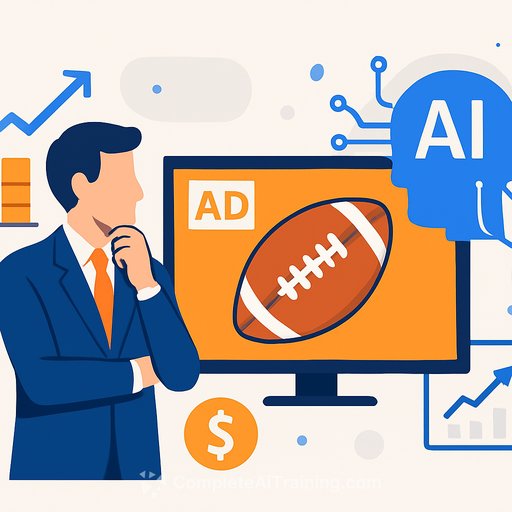
AI didn't just show up at the Super Bowl - it took a seat at the most expensive table in media. And the message was clear: consumer mindshare is now the battleground.
Claude's campaign stood out because it embraced the "chatbot voice" we all recognize - the pause, the polished phrasing, the hyper-helpful tone - and turned that friction into a wink. It felt self-aware, human, and confident. That's brand strategy doing real work.
Market Overview
- AI ads are now going straight to consumers, not just enterprise buyers.
- Compared to frontier-model costs, premium media buys look small.
- Brand recognition is emerging as a competitive lever alongside compute and talent.
Why Claude's Spot Worked
Most AI ads try to look "smart." Claude's ad sounded familiar. It leaned into the cadence people actually experience in chat - the almost-too-helpful assistant - and made it a feature, not a bug.
That's the move: use cultural fluency to reduce uncertainty. In a space where many tools feel interchangeable, familiarity and trust are the difference between "I'll try it" and "I'll switch my default."
The Economics: Super Bowl Spend Looks "Cheap" Next to Compute
A $10M airtime buy (call it $20-30M all-in) sounds aggressive - until you stack it against model training, inference, and top-tier AI compensation. In that context, a massive media moment isn't a splurge; it's distribution at scale.
If habit becomes the moat, buying familiarity early is efficient. The cost of shifting user defaults later is far higher than the cost of a cultural spike now. For context on pricing and reach, see recent reporting on Super Bowl ad costs here, and big-picture AI economics here.
Distribution Now Rivals Research
We've seen this movie with platforms that prioritize engagement and reach. In AI, Meta and OpenAI are strong reminders: distribution, ecosystem, and daily active behavior can rival pure research as growth engines.
As performance converges for everyday tasks, brand and placement decide who becomes the default. That's why this isn't just a tech race. It's a habit race.
Bull Case
The Super Bowl wave signals a clean shift to mass consumer adoption. Claude showed that personality and UX can differentiate as much as benchmarks - opening a lane where creative strategy, trust cues, and cultural timing matter.
Relative to billion-dollar model cycles, a $20-30M cultural moment is a capital-efficient way to buy distribution and lock in habits before switching costs harden. If outputs feel similar to most users, the brand that feels safest and most familiar will pull ahead. Expect a broader marketing cycle as labs battle for mindshare and top-of-funnel scale.
Bear Case
Big spend may be early if most users can't tell assistants apart. Awareness doesn't guarantee conversion or loyalty. Brand wars can turn into margin-eating stalemates where everyone pays more to stand still.
Over-rotating to distribution invites risk if a rival ships a true leap. Habits shift fast when advantage is obvious. Add the cost pressure of compute plus premium media, and pre-profit firms face tight runways. One public failure or policy hit can undo months of brand work overnight.
The Deeper Question: Are We Competing on Story Now?
Most people can't consistently tell which model is "best," especially through similar interfaces. If perceived quality is murky, familiarity becomes the moat. The assistant that feels known, safe, and everywhere wins by default.
That's why the Coke-versus-Pepsi analogy matters. If the next phase is fought on identity, habit, and distribution, storytelling sits beside benchmarks. The winner might have the strongest model - and the strongest story.
What Marketers Should Do Next
Build Familiarity Moats
- Name the voice. Document tone, rhythm, and boundaries. Make the assistant feel consistent across ads, product, and support.
- Design trust into the experience: transparent handoffs, clear limitations, instant undo, visible privacy cues.
- Turn quirks into signatures. If there's a recognizable cadence or UX pattern, own it.
Buy Distribution Intentionally
- Prioritize placements that create default behavior: keyboards, browsers, productivity suites, and OS-level hooks.
- Use cultural spikes to compress adoption windows. Big moments work if you pair them with frictionless onboarding and sticky loops.
- Negotiate bundles: free trials, credits, and integrations that make "try it" the path of least resistance.
Measure What Actually Predicts Retention
- Track habit, not just clicks: day-7/day-30 active use, sessions per week, and task completion rates.
- Attribute lift from brand moments to downstream behavior: saves, shares, return sessions, and workspace embeds.
- Instrument "trust events": users reading policies, adjusting settings, undoing an action - and returning after.
Creative Principles for AI Advertising
- Speak to use cases people repeat daily. Specific beats grandiose.
- Show the assistant working with human judgment, not replacing it. It calms anxiety and boosts trial.
- Own a category "why." Speed, safety, sourcing, or style - pick one and hammer it.
Pricing and Offer Strategy
- Anchor value to time saved per week and outcomes achieved, not abstract features.
- Bundle premium features around recurring workflows (docs, meetings, analysis) to encourage habit.
- Offer lightweight, step-up paths so casual users can become power users without friction.
Risk Management (Because Trust Is Fragile)
- Pre-build a crisis playbook for model errors, hallucinations, and data issues. Speed matters more than perfection.
- Use staged rollouts and guardrails for high-visibility integrations. Fewer surprises, better stories.
- Close the loop publicly when you fix something. Credibility compounds.
KPIs to Watch After a Big Media Moment
- Trial-to-weekly-active conversion within 14 days
- Number of default placements won (and utilization rates)
- Share of branded queries vs. generic AI queries
- Cost per retained weekly active user (not just cost per sign-up)
- Cross-surface consistency (mobile, desktop, extensions, embedded tools)
Looking Ahead
Expect AI firms to escalate spend to lock in daily habits before the market settles. As models cluster around "good enough" for common tasks, brand will call the shot more often than specs.
If this turns into a Coke-Pepsi era for AI, the smart money goes to companies that combine two muscles: consistent technical progress and ruthless clarity in story, voice, and distribution.
Your Next Step
If you lead marketing, study how Claude turned a known tension - the chatbot cadence - into a memorable identity. Then pressure-test your own assistant's voice, trust signals, and default placements.
Want structured training to bring your team up to speed on AI use cases, prompts, and tooling? Explore our practical resources for marketers here or browse the latest AI courses here. Build the skills, then buy the moments.
Your membership also unlocks: