A Warning to the Young: Just Say No to AI
There is a silent threat to genuine thinking that targets a whole generation. The rise of Large Language Models (LLMs) risks replacing authentic reasoning with artificial shortcuts. What’s at stake is nothing less than the life of the mind itself.
Our devices have long given us access to vast information, but they also chip away at our ability to focus deeply. That’s a familiar challenge. Yet, the newest threat is far more damaging, especially for young learners still shaping their capacity to think critically and write thoughtfully. The path to wisdom is long and requires serious reading, writing, and reflection. AI shortcuts could derail this essential process.
The Real Purpose of Writing
Consider the role of writing in education. It’s not about producing flawless papers using any tool available. Writing is the practice ground for thinking. When students rely on AI to generate their work, they miss the vital exercise of organizing thoughts and articulating understanding. This undermines growth.
Clear writing matters beyond the classroom. Success in many careers depends on the ability to communicate persuasively. Yes, AI might produce clear text, but if that text isn’t your own thinking, it’s a hollow victory. Writing and reasoning are inseparable; one cannot exist meaningfully without the other.
Why Writing Equals Thinking
Years ago, a professor made a simple, profound point: if you can’t put your thoughts into words, you haven’t truly thought them. Writing is not just a way to present ideas; it is the very process of forming them. This essential discipline is at risk when AI is used as a crutch rather than a tool.
Historical Context: Technology’s Trade-Offs
Technology has always altered human nature. Mastering fire changed our biology and brains. The printing press shifted memory demands from mind to paper. Music recording reduced the need for everyone to make music together. These shifts brought gains but also losses.
Today’s AI threatens a deeper loss: the erosion of independent thought. Unlike past technologies, this one offers to replace the core human activity of reasoning. That’s not a small price to pay.
Intellectual Freedom at Risk
Freedom begins with the ability to think clearly and question deeply. Philosophy and strategy—both critical to preserving free societies—depend on active reasoning. If AI encourages passivity in thought, it endangers not just individuals but the very fabric of freedom.
Strategy, in particular, requires human judgment. Without a well-trained mind exposed to quality reasoning, strategic thinking falters. This has profound implications for society and national destiny.
Practical Steps Forward
Institutions must adapt. They should prioritize in-class writing and oral examinations to ensure authentic student work. These approaches encourage real engagement rather than reliance on AI-generated content.
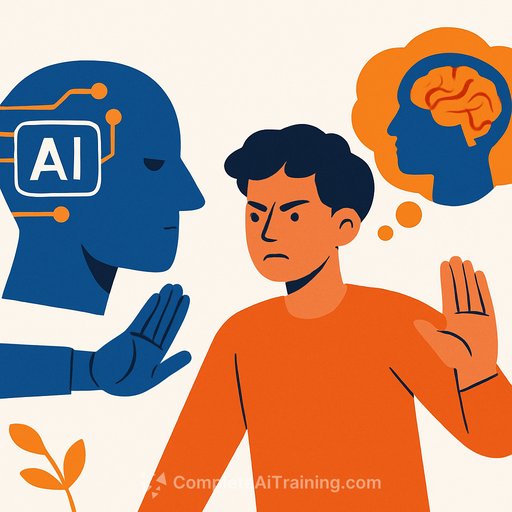
For individuals, the advice is clear: resist the urge to outsource your thinking to AI. Use these tools sparingly and never as a substitute for your own mental effort. The future depends on your ability to read carefully, think critically, and write clearly.
Be the thinker, not just the user of AI. Your intellectual freedom, and by extension your freedom as a citizen, begins in your own mind. Refuse shortcuts that weaken that freedom.
Further Learning
- Explore AI courses by job role to understand AI responsibly.
- Stay updated on the latest AI courses that emphasize ethical and mindful use.
Your membership also unlocks: