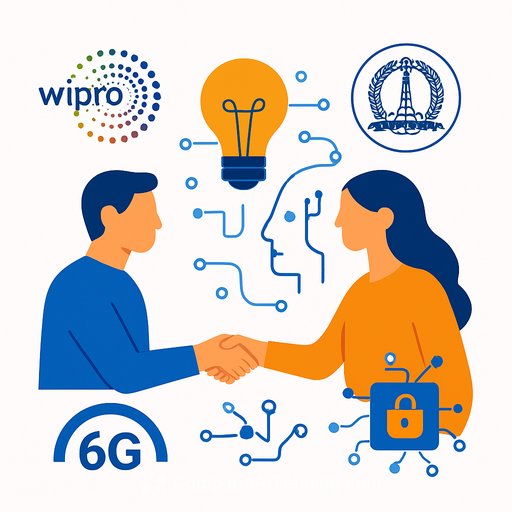
Wipro and IISc partner on agentic, embodied, and quantum AI for secure, autonomous operations
Wipro has partnered with the Foundation for Science Innovation and Development (FSID) at the Indian Institute of Science (IISc) to launch a joint research program. The focus spans agentic AI, embodied AI, quantum AI, quantum-safe solutions, quantum computing, advanced AI models, and secure digital infrastructure.
The goal is clear: help enterprises build secure, adaptive, and autonomous digital operations. The work also points to use cases relevant for future 6G environments.
What the research covers
- Agentic AI: systems that plan, act, and learn across workflows with human oversight and auditability.
- Embodied AI: AI connected to sensors, devices, and robots to close the loop between perception and action at the edge.
- Quantum AI and quantum computing: algorithms and architectures that use quantum resources for optimization and simulation.
- Quantum-safe security: cryptography, key management, and migration strategies resilient to quantum attacks.
- Advanced AI models and secure infrastructure: scalable models and engineering practices for privacy, safety, and deployment.
How the program is structured
The initiative brings together senior faculty, researchers, and scientists from IISc with engineers, architects, and technologists from Wipro. The intent is to move from research to prototypes that can be validated in enterprise environments without losing scientific rigor.
Why it matters for science and research teams
- Enterprise operations: agent workflows for ticket triage, incident response, and change management with clear policy controls.
- Cyber-physical systems: embodied agents for facility monitoring, predictive maintenance, and edge autonomy.
- Security posture: practical paths to post-quantum cryptography, including inventories, crypto agility, and hybrid modes.
- Networking R&D: co-design of AI and wireless for 6G, covering network sensing, scheduling, and efficiency.
6G context
Outputs from this collaboration are expected to inform future 6G systems where AI-native networking and edge compute converge. For reference, see the ITU's IMT-2030 vision for 6G.
Quantum-safe transition
Long-lived systems need plans for post-quantum cryptography. NIST has selected algorithms for standardization and provides migration guidance that teams can start adopting now.
What to watch next
- Open technical reports, reference architectures, and benchmarks released from the program.
- Pilots that demonstrate agentic workflows with safety checks, policy enforcement, and measurable uptime gains.
- Tools and playbooks for PQC readiness across software, firmware, and network layers.
Further reading and training
- AI courses by job for R&D teams building agent-based systems and secure AI pipelines.
Your membership also unlocks: