
AI news ·
WIRobotics releases ALLEX humanoid robot simulation model for physical AI development
WIRobotics released the ALLEX humanoid robot simulation model on GitHub for algorithm testing. The digital twin follows the company's recent $70 million Series B funding.
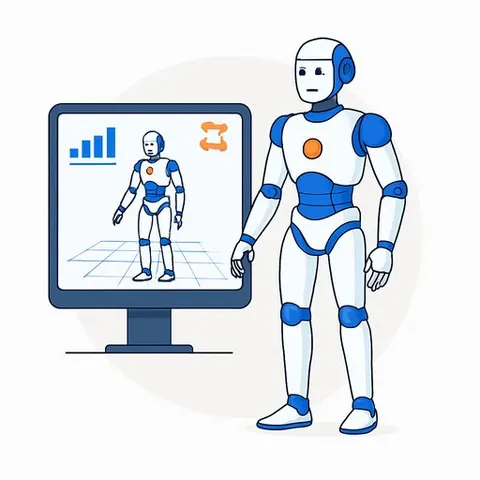
WIRobotics, a South Korean robotics company, has released the simulation model of its humanoid robot ALLEX as the first step in building an open Physical AI development ecosystem. The release gives developers and researchers access to a high-fidelity digital twin that closely mirrors the physical robot's behavior, enabling algorithm testing and synthetic data generation without hardware.
The model is available in three standard formats-MJCF for MuJoCo, USD for Isaac Sim, and URDF for ROS-and can be downloaded from the company's GitHub repository. A technical validation video on YouTube demonstrates the consistency between simulation and the real robot.
Physical AI and the simulation-first approach
Across the robotics industry, Physical AI-which enables robots to perceive, reason, and act in the physical world-is becoming a core focus. For humanoid robots, development approaches that rely on simulation environments accurately reflecting real-world hardware are expanding quickly. WIRobotics aims to go beyond in-house development by creating an open ecosystem where external researchers can validate algorithms and AI models through simulation before commercial hardware is available.
Closing the Sim-to-Real gap
The ALLEX simulation model is built to minimize the gap between simulated and physical behavior. It precisely reproduces the robot's high backdrivability and force transparency, characteristics that make the real robot's movements closely match an ideal simulation. This Real-to-Sim fidelity means researchers can run control, learning, and data generation experiments with confidence that results will transfer to physical hardware.
What the leadership says
Yong-Jae Kim, Co-CEO of WIRobotics, said: "In humanoid robot development, simulation models are a core infrastructure that serves as the foundation for learning, validation, and synthetic data generation. A simulation environment that effectively reflects the characteristics of the real robot enables developers to validate algorithms more quickly and increases the potential for successful deployment on physical hardware."
He added: "We plan to make the ALLEX research platform available later this year. By releasing the ALLEX simulation model, we hope more developers will begin ALLEX-based research even before the hardware becomes widely available. We will continue expanding a development ecosystem where research outcomes can ultimately be applied to real robots."
What's next for the ecosystem
This release is the first in a planned series of technology disclosures from WIRobotics' humanoid robot program. The company intends to release additional core technologies to further expand the Physical AI development ecosystem. Meanwhile, the ALLEX research platform is expected to become available later this year, giving developers a physical target for their simulation-tested algorithms.
Company background: Founded in 2021 by former Samsung Electronics robotics engineers, WIRobotics develops wearable robots and humanoid robots. Its WIM series received CES Innovation Awards from 2024 through 2026. In 2025, the company unveiled the ALLEX humanoid platform, and in 2026 it was selected for the Physical AI Fellowship by NVIDIA and AWS. It also closed a Series B funding round of approximately KRW 95 billion (around USD 70 million) in 2026.
Why this matters for IT and development professionals
For developers working in robotics, AI, or simulation, this release lowers the barrier to entry for humanoid robot research. A validated, high-fidelity simulation model available in standard formats means you can start prototyping control algorithms, reinforcement learning policies, or synthetic data pipelines immediately, using tools you already know like MuJoCo, Isaac Sim, or ROS. The reduced Sim-to-Real gap also increases the likelihood that your simulation results will translate to real-world hardware, making it a practical sandbox for building skills and testing ideas before committing to physical robots.