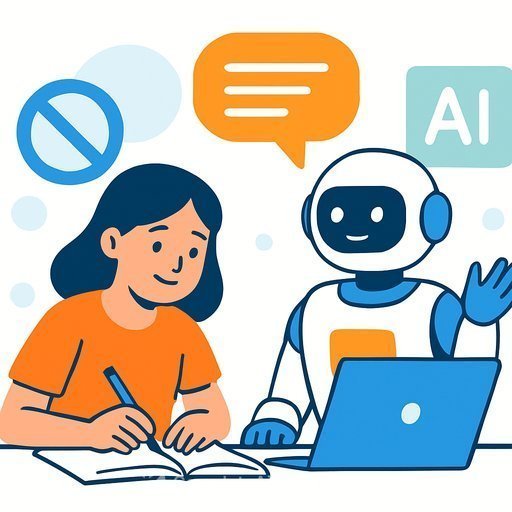
How should college students be evaluated in the age of AI?
Students can open ChatGPT, Claude, or Gemini in seconds. That changes the surface of assignments, not the substance of learning. If 85% of students are using AI in some way for coursework, grading needs to measure thinking, transfer, and judgment - not just polished outputs.
The goal isn't to shut down AI. It's to make thinking visible, set clear boundaries, and reward the skills that AI can't fake consistently: problem framing, evidence-based reasoning, and accountable collaboration.
What outcomes should we assess now?
- Concept mastery: core knowledge, definitions, and why they matter.
- Reasoning: how students move from prompt to method to result.
- Transfer: applying knowledge to new, specific, or messy contexts.
- AI literacy: appropriate tool selection, prompt strategy, verification, and citation of AI use.
- Ethics and professionalism: boundaries, attribution, and data privacy.
Write an AI-use policy that reduces guesswork
Make expectations explicit at the course level. Students need to know what's encouraged, what requires disclosure, and what crosses a line.
- Permitted uses: list tasks where AI is allowed (e.g., brainstorming, grammar checks, code refactoring).
- Prohibited uses: list tasks where AI is not allowed (e.g., full solution generation, literature summaries, exam responses).
- Disclosure: require an "AI use report" with prompts, tools, and how outputs were verified.
- Originality: define what "your own work" means when AI is involved.
- Equity and access: offer alternatives if a tool is blocked or paid; avoid forcing personal logins that raise privacy concerns.
- Consequences: map violations to your academic integrity code with clear examples.
Assessment designs that surface thinking (and discourage shortcuts)
- Process grading: collect drafts, version history, prompt logs, and a short reflection explaining key decisions.
- Oral defenses: 5-7 minute micro-vivas where students explain choices, limits, and next steps.
- In-class build sprints: time-bound tasks with permitted tools and visible work-in-progress.
- Contextualization: require local data, original datasets, or course-specific constraints that generic models won't anticipate.
- Parameter variation: same core problem, different inputs per student; grade on method and reasoning, not only the final number.
- Portfolio over time: repeated artifacts that reveal growth, feedback uptake, and consistent voice.
- Peer review with calibration: students give structured feedback tied to the rubric; you grade both the work and the review quality.
- Multimodal evidence: quick screencasts, whiteboard photos, or code walkthroughs verifying authorship and understanding.
Make AI use visible and assessable
Don't punish disclosure; reward responsible use. Add a graded "AI use report" to relevant assignments:
- Tools used and why (model name, version if possible).
- Exact prompts and settings; what you changed after each response.
- Verification steps (sources checked, tests run, contradictions found).
- What the AI got wrong and how you corrected it.
- Estimated time saved and how you spent that time instead.
- Any ethical or privacy considerations.
Cheating, detection, and fairness
- Avoid heavy reliance on AI "detectors." They often produce false positives and can penalize multilingual students.
- Use assessment design, not policing, to lower misuse: more process evidence, oral checks, and contextual tasks.
- Be consistent: if AI is banned on an activity, say why and assess the underlying skill directly.
- Document patterns: when misconduct is suspected, gather process artifacts and compare to prior work, then follow policy.
Rubrics that work with or without AI
- Problem framing (20-30%): clarity of question, assumptions, constraints.
- Method and justification (25-35%): choice of approach, sources, and why they fit.
- Evidence and verification (15-25%): tests, citations, error analysis, limitations.
- Outcome quality (15-25%): correctness, relevance, and usability.
- Reflection and AI disclosure (10-15% when applicable): how tools were used and what the student learned.
Course logistics to sort early
- Access: provide institutionally vetted tools or clear alternatives.
- Privacy: discourage uploading sensitive data to public models; offer local options when needed.
- Training: spend one class on AI strengths, failures, and your policy; model acceptable use.
- Accommodations: ensure any oral or in-class elements have equitable alternatives.
Quick-start plan for next term
- Update the syllabus with a clear AI policy and examples.
- Convert two major assignments to include process artifacts and an AI use report.
- Add one short oral defense checkpoint per student.
- Revise one quiz or lab with randomized parameters and context-specific data.
- Pilot a portfolio that tracks drafts, feedback, and revisions across the term.
Professional development
If you want structured training and examples, explore the AI Learning Path for Teachers for strategies on assessment, lesson design, and responsible classroom use.
Bottom line
AI lowers the cost of producing passable work. Your assessments should raise the value of original thinking. Measure process, context, and judgment, and you'll get the learning you want - with or without AI in the mix.
Your membership also unlocks: