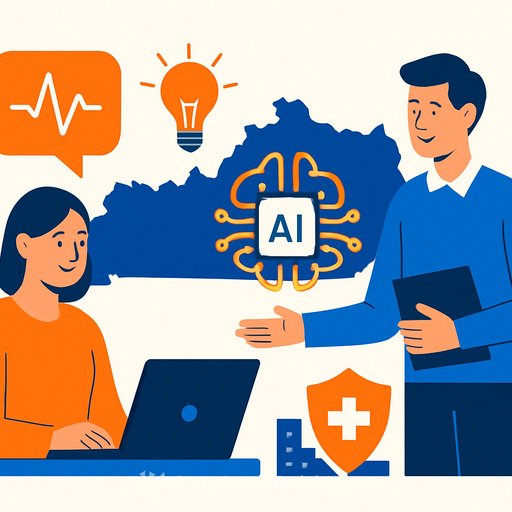
WKU Disaster Science Operations Center Partners with EM1 to Advance AI-Driven Emergency Management
The Western Kentucky University Disaster Science Operations Center (DSOC) has formed a new partnership with EM1, an AI-driven platform built for emergency management operations. The agreement, initiated at the recent International Association of Emergency Managers meeting, includes donated licenses so DSOC can stress test the system, develop use cases, and provide feedback that speeds up real-world improvements.
DSOC operates within WKU's Ogden College of Science and Engineering and the Department of Earth, Environmental, and Atmospheric Sciences. It supports live operations across a wide range of events and hazards, working with partners such as Chicago Event Management, Beam Suntory, AT&T FirstNet, the National Cherry Blossom Festival, and the FBI. Bringing EM1 into that environment expands applied research and hands-on learning for students who directly support field operations.
Why this matters for operations
Emergency managers and operations leaders need faster planning cycles, cleaner data, and repeatable workflows. This partnership targets those needs: automate administrative load, tighten data pipelines, and pressure-test plans through exercises that mirror real incidents.
- Faster planning and documentation: auto-generate incident briefs, IAP inputs, and after-action summaries.
- Higher signal data: integrate quality-controlled feeds to reduce noise during high-tempo periods.
- Better training at scale: spin up tabletop exercises and injects without weeks of prep.
- Operational learning loop: capture decisions, outcomes, and gaps to improve the next event.
"The EM1/DSOC partnership demonstrates yet another industry partnership that entrusts the research-to-operations integrity that DSOC provides," said Dr. Josh Durkee, Professor in EEAS and University Meteorologist. "DSOC leads Kentucky as the state hub and resource for disaster resilience, innovation, and research, and is the flagship operation of the WKU Consortium of Disaster Science and Management."
"The future of emergency management is a critical lifeline for our country and our communities," said Tyler Felous, Cofounder and CEO at EM1. "We are excited to partner with DSOC to put advanced AI technology in the hands of the next generation of leaders. Their research, creativity, and operational experience will help ground our tools in real-world challenges and accelerate innovation for agencies nationwide."
"This partnership with EM1 is another great example of how we are leading the state and the region in applied disaster science and innovation," said Dr. Leslie North, Chair of the WKU EEAS. "We are incredibly excited about what this collaboration means for our students, our faculty, and our partners, and are so proud to work alongside EM1 in advancing real-world solutions for emergency management."
What EM1 enables inside DSOC
Graduate students inside DSOC are already putting the platform to work. Their focus: improve productivity, strengthen decision support, and create training that matches field reality.
- Workflow efficiency: "By using AI to automate repetitive chores and solve potential issues, I am able to manage my time better, which allows me to focus on analysis and the production of meaningful data," said Harmony Guercio (Homeland Security Science).
- Better planning inputs: "EM1 provides access to quality-controlled data that can be used to write our own plans and gain a better understanding of the emergency management workflow during a crisis or disaster," said Thomas Payette (Homeland Security Science).
- Training at speed: "It will allow us to create tools and exercises that before would have taken considerable time and resources," said Luke Ferguson (Homeland Security Science), who is using EM1 to build tabletop exercises and identify weak points in preparedness plans.
These efforts align with standards-driven operations and incident structures used nationwide. For reference on frameworks many teams track against, see FEMA's NIMS guidance.
Immediate takeaways for operations leaders
- Map your high-friction tasks: status updates, documentation, data pulls, and post-incident reporting. Automate those first.
- Define your data sources and quality rules: what's authoritative, how often it updates, and who owns validation.
- Stand up quick tabletop exercises for your top three risks. Focus on decision points, comms flows, and resource triggers.
- Create repeatable decision-support playbooks: inputs required, thresholds, and who approves.
- Set guardrails for AI use: privacy, accuracy checks, and incident-time escalation steps.
- Track simple KPIs: time to common operating picture, time to first plan draft, and variance between planned and actual resource needs.
Building capability and workforce
DSOC's partnership with EM1 strengthens education, research, and operations in one loop. Students learn by doing, partners gain practical outcomes, and communities benefit from better-prepared teams.
If you're upskilling staff on AI for operations, explore focused learning paths and certifications that emphasize practical workflows: Courses by job and AI Automation Certification.
For more information on the WKU Disaster Science Operations Center, contact Dr. Josh Durkee at joshua.durkee@wku.edu.
Your membership also unlocks: