
AI news ·
Workday and Google Cloud embed AI agents in HR and finance workflows with shared governance framework
Workday and Google Cloud now embed AI agents directly into finance and HR workflows, letting employees approve timesheets and manage expenses inside Gemini without switching apps. Accenture and Alphabet are already using the expanded platform.
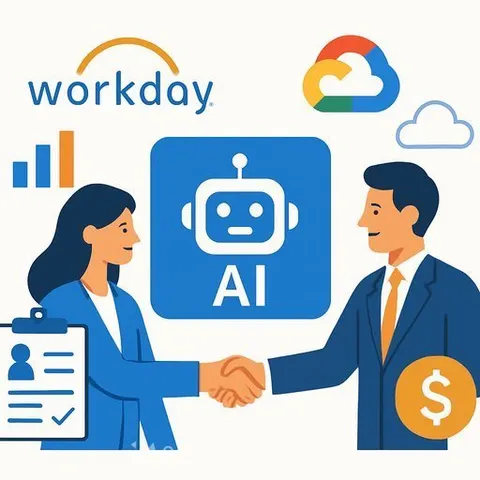
Workday and Google Cloud Embed AI Agents Into HR and Finance Work
Workday and Google Cloud announced an expanded partnership on May 28, 2026, that brings AI agents directly into the applications where finance and HR professionals already work. Workday's Sana Self-Service Agent is now available inside Gemini Enterprise, allowing employees to check balances, approve timesheets, and manage expenses without switching applications. Gemini becomes the default AI model for Sana, adding reasoning and multilingual capabilities to HR and finance tasks.
The shift addresses a core problem in enterprise AI adoption: employees abandon tools that require them to leave their primary workflow. By embedding agents at the point of work, both companies are betting that adoption accelerates when AI meets people where they already spend their time.
Governance as Competitive Advantage
The partnership introduces Workday's Agent System of Record (ASOR), a governance framework that enforces security permissions, business rules, and approval chains across multiple AI agents. In environments where different agents handle different tasks, a single control plane becomes essential for compliance and auditability.
This matters for finance teams because it addresses a historical barrier to AI deployment in regulated functions. ASOR ensures that agents accessing financial data operate within defined policies without requiring custom integrations for each new agent.
The zero-copy data integration between Workday Data Cloud and Google Cloud Lakehouse reinforces this approach. Data stays within Workday's secure environment during analytics, eliminating duplication and reducing exposure.
Real-World Adoption Signals
Accenture and Alphabet are already using the expanded partnership to automate HR and finance operations. Early deployment by system integrators and large enterprises suggests the platform has moved beyond announcement to active use.
The partnership supports Agent-to-Agent (A2A), Agent-to-UI (A2UI), and Model Context Protocol (MCP) standards. These standards allow agents from different vendors to share context and hand off tasks without custom point-to-point integrations, creating a foundation for multi-vendor agent ecosystems.
What This Means for Finance Teams
Finance leaders evaluating AI strategies should track several developments. First, adoption velocity of Sana on Google Cloud's Agent Marketplace will indicate real market demand. Second, whether ASOR becomes an industry reference architecture for enterprise AI governance will determine long-term vendor lock-in considerations.
Competitors including SAP SuccessFactors, Oracle HCM Cloud, and Microsoft are pursuing similar embedded agent strategies. The vendor that establishes the most trusted governance layer and broadest agent ecosystem will likely become the default orchestration platform.
For finance professionals, the practical implication is straightforward: embedded AI agents with built-in policy enforcement reduce compliance risk and adoption friction. Organizations investing in this architecture now are building on standards designed to accommodate future agents without re-architecting integrations.
Watch for deployment outcomes at early adopters over the coming months. Measurable reductions in process cycle times for expense approvals, timesheet processing, and financial inquiries will validate whether multi-agent orchestration delivers real operational gains.
Learn more about AI for Finance and AI for Human Resources to understand how these technologies apply across your organization.