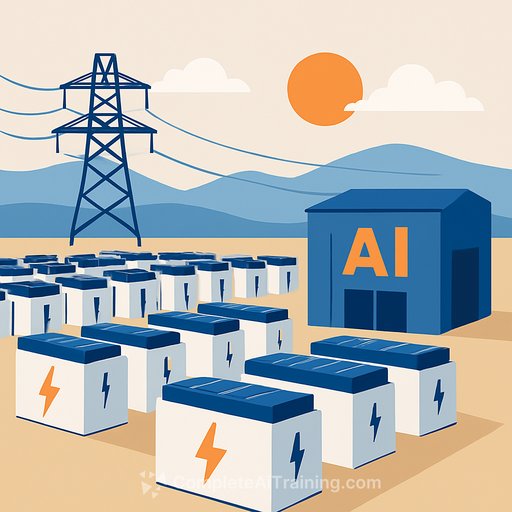
AI-driven 4 GWh battery station goes live in Inner Mongolia: what operations teams need to know
Envision Energy has connected what it reports as the world's largest standalone battery energy storage station to the grid in Inner Mongolia. The site brings 4 GWh of capacity online and uses the company's proprietary AI-driven control and trading systems. With this addition, Envision's developed storage capacity in the region exceeds 14 GWh.
The cluster sets a new benchmark for both scale and grid-connection speed. It's built to help the local system absorb more variable wind and solar while improving day-to-day stability. Expect active participation in the electricity spot market as China leans further into market-based trading.
Why this matters for ops
Size changes the operating playbook. AI changes the profit curve. According to the company, high-accuracy market forecasts at existing Inner Mongolia sites have already improved trading performance, and that precision is projected to lift total life-cycle returns by 20%+.
Operational implications to plan for
- Market participation: Treat this as a multi-service asset (energy arbitrage, frequency response, reserves). Build automated bidding with clear risk limits and price floors/ceilings for the spot market. For context on market design trends, see the IEA's overview of grid-scale storage here and electricity market design here.
- Forecasting and dispatch: Blend AI forecasts with on-site SCADA, renewable output forecasts, congestion signals, and SoC guardrails. Re-optimize intraday as prices, curtailment risk, or grid conditions shift.
- Grid services and stability: Configure fast frequency response, ramping support, and droop settings to local code. Pre-negotiate response priorities with the system operator so trading and reliability services don't conflict.
- Asset health: Cap cycles/day by price threshold and thermal limits, and budget MWh throughput by season. Track temperature spread across racks; adjust C-rates to manage degradation.
- Safety: Validate fire detection, suppression, and isolation routines. Run quarterly drills for thermal events and cabinet-level faults.
- AI/EMS reliability: Define data latency targets, model retraining cadence, and a fallback rules-based schedule if the AI or market data feed degrades.
- Cybersecurity: Segment EMS/SCADA networks, enforce MFA, and monitor vendor remote access. Simulate comms loss and confirm safe default modes.
- Workforce and spares: Staff for 24/7 monitoring during the first quarter. Stock critical components (contactors, BMS cards, fans, filters) with lead-time buffers.
KPIs that actually move P&L and risk
- Availability (%) and forced outage rate
- Round-trip efficiency (%) by temperature band
- Cycle count/day and MWh throughput vs. degradation budget
- SoC window adherence and reserve margin for contingencies
- Forecast error (MAE/MBE) for price and renewable output
- Revenue/MW-day by product (energy, FFR, reserves) and bid hit rate
- Ancillary performance score and penalties avoided
- Curtailment absorbed (MWh) and avoided curtailment value
- P&L attribution: forecast edge vs. execution vs. availability
- Degradation cost/MWh embedded in dispatch decisions
Dispatch playbook to implement now
- Market interface: Lock down APIs, auto-bid rules, and circuit breakers (position and notional limits). Set auto-repricing thresholds for volatility spikes.
- SoC policy: Keep a contingency reserve (e.g., 10-20%) for grid events and ancillary calls. Define exception rules for scarcity hours and system alarms.
- Thermal management: Pre-cool or pre-heat before high-load windows; align charge/discharge with HVAC capacity to preserve efficiency.
- Maintenance windows: Schedule during low-price periods; coordinate with the market calendar and known outage seasons.
- Event drills: Trip events, comms loss, and islanding simulations where applicable. Verify safe-state transitions and restart sequences.
- Reporting and compliance: Automate hourly/daily reports for the operator and internal P&L. Include forecast vs. actual and penalty tracking.
- Operator alignment: Establish a weekly cadence with the TSO/DSO for constraints, curtailment outlook, and planned network work.
What this signals for energy operators
AI-enhanced EMS and trading are moving from "nice to have" to baseline. At 4 GWh scale, execution quality-forecasts, automation, and asset health-will separate top-quartile returns from the rest. Teams that treat data and dispatch as one system will keep the margin.
Further resources
Your membership also unlocks: