AI shocks agency stocks, but strategy just got more valuable
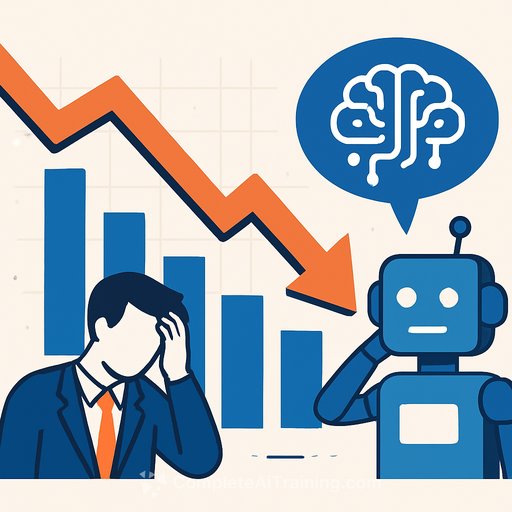
Agency shares slumped in 2025 as AI pulled creative and production costs down. WPP fell about 60% after client losses and is set to drop from the FTSE 100 for the first time in 27 years. Publicis and Omnicom are down too, though analysts have pushed recommendations on those names to multi-year highs.
The market is pricing in displacement. The work is shifting instead. Production is getting automated; allocation, measurement, and brand lift still need expert hands.
What changed this year
- New tools from tech giants: Google's Nano Banana and OpenAI's Sora 2 generate images and video from prompts. Coca-Cola ran a holiday spot built with AI for the second year in a row.
- Platforms keep adding "do-it-for-me" ads: Alphabet and Meta rolled out products that let brands build and launch campaigns without outside help. See Google's Performance Max overview and Meta's Advantage+ suite.
- In-house proof point: Palo Alto Networks said it built an entire campaign internally with no agency.
- Valuations reset: WPP's forward P/E hit an all-time low; Omnicom sits near its 2020 trough; Publicis trades closer to its 10-year average.
- Reshuffling risk: WPP cut guidance twice; Dentsu is reviewing international ops; a reported approach from Havas was later denied.
Why agencies still matter
- Cross-platform allocation: Avoid paying twice for the same person across Reels and Search. Agencies carry decades of audience, media, and response data that expose overlap and waste.
- Personalization at volume: As AI makes content near-instant and hyper-specific, coordination, testing design, and governance increase in difficulty. That's strategy, not just production.
- Lower costs, higher stakes: When creation gets cheaper, the bar for "memorable" gets higher. Expect an arms race among top advertisers to deliver unforgettable brand moments.
What smart marketers do next
- Rebalance budgets: Keep 60-70% in proven channels, 20% for AI-enabled creative and iteration, 10-20% for experiments (new formats, shoppable video, UGC-style variants).
- Tighten KPIs: Bias to incrementality tests, CAC/LTV by audience, blended ROAS tied to contribution margin, and overlap metrics (frequency caps, unique reach, CPM vs CPA drift).
- Split the work: In-house a lean content cell (prompting, versioning, brand voice); use agencies for media mix design, measurement frameworks, creative platforms, and compliance.
- Clean first-party data: Enrich CRM, fix UTM discipline, and stand up a creative/offer matrix by segment to feed models with better inputs.
- Build guardrails: Set brand rules, disclosure for synthetic media when needed, human QA for high-reach assets, and rights management for all AI outputs.
90-day execution plan
- Weeks 1-2: Audit channel overlap; move 5-10% of creative spend to AI-generated variants with strict testing plans; standardize prompts and brand guidelines.
- Weeks 3-6: Run geo-split or audience-split lift tests; deploy MMM or lightweight media attribution; pilot 1 AI video and 1 image tool tied to clear KPIs.
- Weeks 7-12: Scale winning variants; renegotiate agency scope toward media strategy and measurement; formalize a shared dashboard across in-house and agency teams.
Signals to watch
- CPM and conversion trends as AI content volume surges.
- Adoption of Performance Max and Advantage+ vs. manual buying. Higher platform automation often pushes more work in-house.
- Holding-company M&A and client churn at WPP relative to peers.
Bottom line
AI compresses production costs and raises strategic complexity. Agencies that move from "making ads" to "orchestrating media, measurement, and brand impact" will keep their seat. Marketers who pair in-house AI speed with agency-level planning will outspend rivals efficiently and win share.
Want a faster skill upgrade for your team?
For marketers building AI fluency without the fluff, consider this focused program: AI Certification for Marketing Specialists.
Your membership also unlocks: