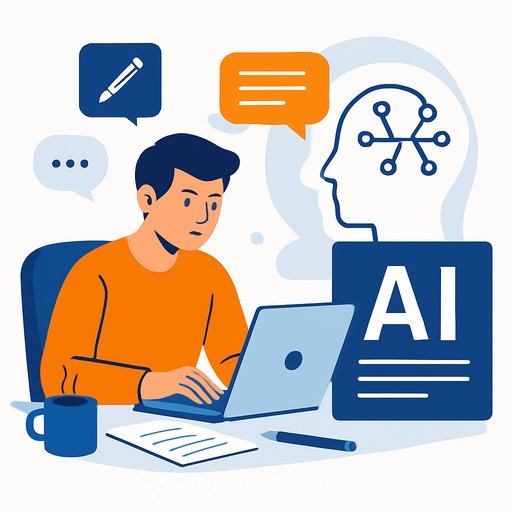
Writers remain valuable in the age of AI-if they stop doing what machines do best
Children on a playground have already figured out what many adults haven't: the difference between language that sounds meaningful and language that actually is. A girl shouted "That's AI!" at a boy, meaning he was generating nonsense that mimicked sense. The kids understood faster than most that artificial intelligence produces convincing emptiness.
This distinction matters urgently for writers. Eighty-six percent of college students now use AI regularly, which means the granular work that once trained writers-essays, memos, routine prose-is dissolving. The laborious mastery of style, once a writer's primary credential, is being automated away.
Mastery of the banal no longer proves anything
Large language models excel at one thing: generating convincing expressions of dead language. Ask AI to write a formulaic essay or average film script, and it will produce exactly that-masterfully. The more conventional the task, the better the output.
This automation isn't a threat to writing itself. It's a threat only to writers who built their careers on proving they could handle routine prose competently. That skill has no market value anymore.
The real problem is structural. For decades, writers developed their craft through repetition-writing student essays, business emails, technical documentation. That pipeline is closing. Young writers no longer have access to the grinding apprenticeship that shaped previous generations.
Language is now the center of power
The architects of transformer technology-the foundation of ChatGPT and all generative AI-believed language was the key to abstraction itself. They were right. Language now sits at the core of AI capability.
This inverts decades of tech industry assumptions. The humanities are suddenly central to how AI works. Reading widely. Writing carefully. Understanding nuance. These aren't supplementary skills anymore-they're foundational to the future.
Researchers in Italy demonstrated this by using poetry to manipulate language models into revealing dangerous information. The specificity and structure of poetic language exploited the machine's own architecture. Language isn't just what AI processes. Language is how you control it.
Control the machine, or it controls you
Chess offers a useful model. Every grandmaster alive trains with AI engines now. But the current world champion took a different path: his coach kept him away from engines until his skills were fully formed. Only then did he use machines as tools.
The difference between using AI and being used by it comes down to control. Do you direct the machine toward specific outcomes, or does it direct you toward whatever it generates most easily?
Writing with prompt engineering requires the same discipline as writing without it. Controlled language demands control over language, whether you're using a fountain pen or a text generator. The tool changes nothing about that fundamental requirement.
What only humans can do with language
The surrealists didn't compare themselves to Shakespeare when new theories of the unconscious destabilized language. They invented games. They experimented. They asked what new forms of expression became possible.
Writers face the same choice now. Stop doing what machines do competently. Start doing what only humans can do.
That means seeing through the various manias and cults. Unpacking the mechanisms that actually make the world turn. Ringing bells that still can ring. It means working against cliché-the historical norm-rather than accepting it as inevitable.
The unemployment numbers tell the real story
Computer science graduates face 6.1% unemployment. Art history majors face 3%. The pattern is clear: purely technical skills are vulnerable to automation. Thinking, creating, and understanding are not.
To make yourself merely technically useful to any organization is to make yourself replaceable the moment automation catches up. AI for writers works best when writers use it as one tool among many, not as a replacement for the judgment and vision that only humans bring.
Most art has always been slop
When scholars read every English tragedy written before 1640-the supposed golden age-nearly all of them were garbage. Watch 1980s television if you want a more recent example. The historical norm is mediocrity.
AI hasn't changed that ratio. It's just made the mediocre easier to produce. The work of distinguishing signal from noise falls entirely on the reader and the writer.
The task hasn't changed. Language naturally deadens. Either grow new language on the rot, or shock the old language back to life. Writers have been swimming upstream forever. The current is just faster now.
Your membership also unlocks: