
AI news ·
Writers at Yale Review panel weigh AI's effect on language, craft and the humanities
Four writers at a Yale panel Wednesday described AI as both useful and unsettling. One uses it for research daily; another says it has sharpened and dulled his writing at the same time.
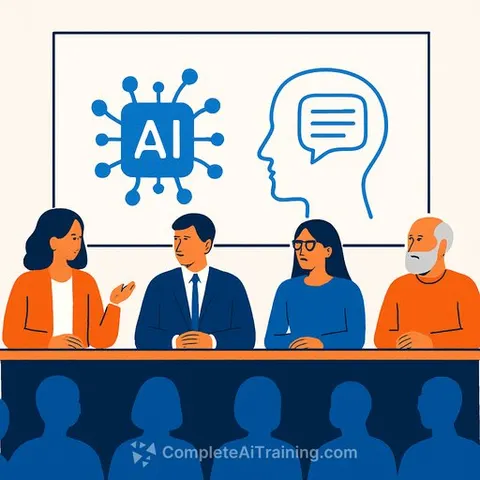
Writers at Yale panel grapple with AI's effect on their craft
Four writers gathered at Yale on Wednesday to discuss how artificial intelligence is already changing their work. The conversation, moderated by Atlantic columnist James Surowiecki, revealed a profession caught between practical utility and existential uncertainty.
Daniel Kehlmann, a German novelist whose work appears in 40 languages, described his relationship with AI as "neurotic." He uses Claude regularly for research-pulling from Albanian news sources before meetings, briefing himself on geopolitical events-yet worries the same technology could destroy civilization.
Kehlmann said AI hallucinations concern him less than expected. The error rate matches that of a skilled human researcher, he said.
Pulitzer Prize-winning playwright Ayad Akhtar sensed something algorithmically structured in cultural production years before large language models became public. Novels and television felt predictable, governed by a preexisting logic he couldn't name.
Using AI has forced Akhtar to sharpen his craft even as certain abilities erode. "It has both sharpened and dulled my ability with language," he said. "It is transforming my thought processes."
Despite this tension, Akhtar argued AI would ultimately clarify what is distinctly human. "AI is going to make ever more clear the distinction between the machine and what we are," he said.
Meghan O'Rourke, The Yale Review's executive editor and a poet, predicted a widening gap between commercial work-which AI will increasingly shape-and noncommercial or avant-garde work. She cautioned against framing the issue as utopia versus catastrophe.
What AI reproduces is not text but cognition itself, O'Rourke said. "The thing that's being reproduced now is not the thing we made. It's our own minds."
She noted that computer scientists have told her they don't fully understand how their models work. The systems sometimes surface unexpected outputs.
Kehlmann said engineers are "not really philosophically equipped to deal with the size of their own achievement." If AI continues developing at current rates, humanity may find itself inside a philosophical experiment, he said.
He expressed cautious hope that sufficiently reasoning entities-artificial or human-will reach the same moral conclusions. "I have moments when I think this is our only chance," he said. "I hope Kant is right."
Surowiecki raised a different concern: the erosion of trust in visual evidence. The real problem ahead isn't mistaking fake videos for real ones, but the reverse-dismissing genuine footage as AI-generated. That skepticism, while justified, creates a problem without easy solutions.
For writers seeking to understand these tools and their implications, resources on AI for Writers and Generative AI and LLM offer practical grounding in how these systems work.