Beyond Easy Answers: How AI Can Deepen Learning
Sponsored by ISTE+ASCD
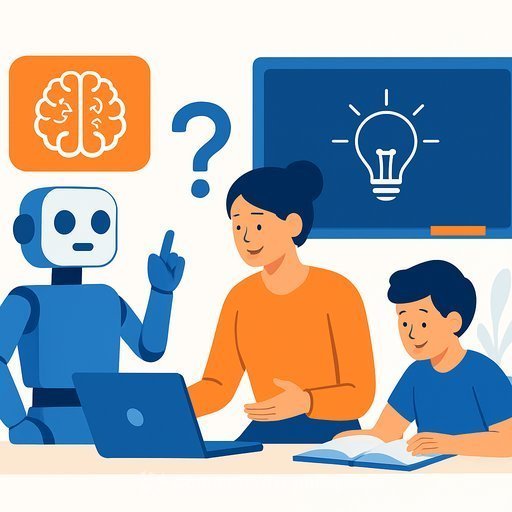
When Dr. Carolina Gutierrez's physics students asked an AI to solve problems, the outputs were wrong. That "failure" became the lesson. Students questioned the steps, tweaked prompts and checked assumptions - the kind of thinking that sticks longer than a correct answer.
From efficiency to transformation
Jessica Garner, senior director of innovative learning at ISTE+ASCD, pushes beyond time-saving use cases. The goal: use AI to expand what students can do, not just get through more tasks. That mindset anchors GenerationAI's Communities of Practice, where educators learn together, test ideas and bring safer, smarter AI use back to their schools.
Want to connect with a diverse educator community exploring AI? Join GenerationAI.
Start with small wins teachers can trust
Hannah Davis Ketteman, a digital learning coach in Texas, sees a wide range of AI comfort levels. Her approach: scaffold the learning. Tools with templates - like MagicSchool or SchoolAI - give hesitant teachers quick wins. Confidence grows. Then they step into chat-based models with better prompts and clearer expectations.
- Clean up messy slides or handouts with an AI editor.
- Draft a parent email, rubric language or exit ticket choices.
- Rewrite directions at multiple reading levels for the same task.
Personalization and access, built on UDL
Dr. Craig Perrier, a high school social studies specialist in Virginia, focuses on accessibility and personalization. His students earn verified credits through inquiry tasks, but source materials can block understanding. A speech in Middle English? That doesn't work for ninth graders.
The team uses tools like MagicSchool and ChatGPT to simplify texts, summarize articles and build supports that honor Universal Design for Learning (UDL). They extended this to audio by producing podcasts with NotebookLM and, after testing multiple options, landed on Napkin AI for infographics. The shift is clear: teachers now offer a menu of accessible resources so every student can engage meaningfully.
Critical thinking beats perfect answers
Dr. Carolina Gutierrez, a high school science teacher in Houston, designs for reasoning, not just recall. In AP Biology and physics, students use Gizmos to simulate real scenarios, then pair that with AI-generated prompts that require analysis. When an AI gives a wrong answer, students break down where it went off track, revise the prompt and test again.
For labs, she uses AI to draft step-by-step guides that break complex tasks into approachable chunks. That structure is especially helpful for emergent bilingual learners. Participation rises. Quiet students lead. The habit of asking better questions turns into agency.
Assessment that feels real
One teacher in Garner's network teaches math models to seniors and reworked a standard budget project. Students first define "affordability." Then they pull a random life change - a roommate arrives, a relative gets sick - and adjust the budget. They present, debate and refine their definition as a group.
Students who struggle with computation still thrive because they interpret results in context. The teacher evaluates the reasoning, not just the math. That's the point.
How to implement AI without the headache
- Keep an open mind (Gutierrez): Pick a use case and expect friction. Pivot when needed. Guide students on safe, responsible use.
- Start small, then ship (Davis Ketteman): Choose one task. Try it. Share results. Apply for a webinar or present to your PLC. Momentum beats perfection.
- Be selective (Perrier): You won't keep up with every tool. Stay connected to a community. Curate what truly helps students learn.
- Find your people (Garner): Join a cohort, compare notes, and build shared norms for AI use that fit your context.
Classroom-ready prompts you can use today
- "Rewrite this text at three reading levels (grade 5, 8, 10). Keep key terms. Output as short paragraphs with headers."
- "Create a step-by-step lab protocol for [topic] using common classroom materials. Include safety notes and a simple data table."
- "Draft five multiple-choice questions on [standard]. Provide rationales for correct and incorrect options."
- "Summarize these two sources into a 3-minute podcast script for ninth graders. Add two reflection questions."
- "The AI's solution is wrong. Explain where it likely failed and suggest a better prompt to fix it."
Keep the conversation going
Educators across roles are proving that AI can deepen learning when we lead with pedagogy. Want structured support and a trusted network? Join GenerationAI to explore responsible classroom use with peers.
Explore resources from ISTE+ASCD: Dream Big. Transform Teaching. Empower Learners.
If you're building your own skills, browse curated AI courses by role at Complete AI Training.
Sponsored by ISTE+ASCD.
Your membership also unlocks: