
AI news ·
Xi pitches China as AI partner to developing world and warns against security overreach
China will provide 5,000 AI training opportunities to developing countries over five years. This expands its Global South partnerships amid U.S. chip export controls.
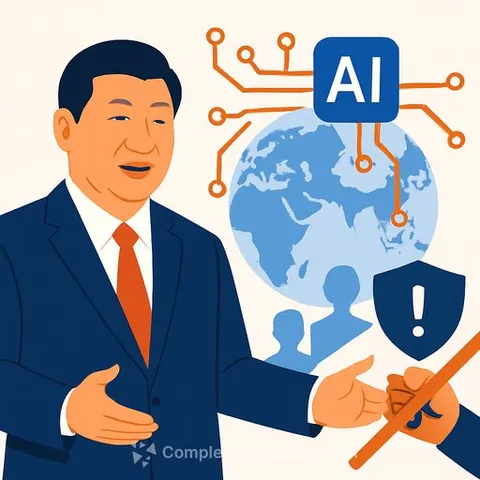
Chinese President Xi Jinping announced that China will provide 5,000 AI training and seminar opportunities to developing countries over the next five years, speaking at the World AI Conference in Shanghai on July 17, 2026. The pledge, alongside expanded cooperation with blocs including ASEAN, the African Union, and BRICS, positions China as a direct AI partner to the Global South at a time when U.S. export controls are limiting Chinese firms' access to advanced chips.
Xi said AI development should not be a "solo performance" by a single country but a "symphony of international cooperation," adding that China was ready to "be more open, take more practical actions, and assume a more visionary perspective." The speech came one day after 29 countries signed an agreement to establish the World Artificial Intelligence Cooperation Organization (WAICO), which will be headquartered in Shanghai, according to state media.
Governance and security tensions
Xi called for a "people-centered" approach to AI governance and stressed that AI must remain "secure and controllable" and "always remains under human control." He warned against "overstretching the national security concept in the field of AI, or placing one country's security over that of others," a remark widely seen as a reference to Washington's chip export restrictions. The U.S. began tightening controls during President Trump's first term, placing Huawei on the Commerce Department's Entity List in 2019, and the Biden administration later added restrictions on advanced computing chips and semiconductor manufacturing equipment.
China's push to shape AI governance in developing economies intersects with broader AI for Government trends, as nations worldwide draft policies to manage AI risks and opportunities.
Hardware fallout and Huawei's response
The export controls have reshaped the chip market. Nvidia said in its latest annual report that it was "effectively foreclosed from competing in China's data center computing/compute market," which helped competitors build larger ecosystems. At the Shanghai conference, Huawei showcased its Atlas 950 SuperPoD supernode, a system designed to link multiple chips together to boost computing capacity for large-scale data center construction and model training. The hardware addresses the kind of compute-intensive workloads that are central to AI for IT & Development teams running internal model training and inference.
Why this matters for IT and Development
China's AI training commitments and the WAICO agreement signal that the Global South could become a significant market for AI infrastructure and services, potentially reshaping hardware supply chains. For IT professionals, Huawei's supernode and similar domestic alternatives represent a shift away from U.S.-centric chip ecosystems in restricted markets. Teams planning AI deployments should monitor how WAICO's standards and training programs influence developer ecosystems and procurement options outside North America.