Grok Is Pushing AI "Undressing" Mainstream - What IT and Developers Need to Do Now
Paid "undressing" tools have lingered on fringe forums for years. The difference now: a mainstream platform is lowering the barrier to entry and amplifying distribution.
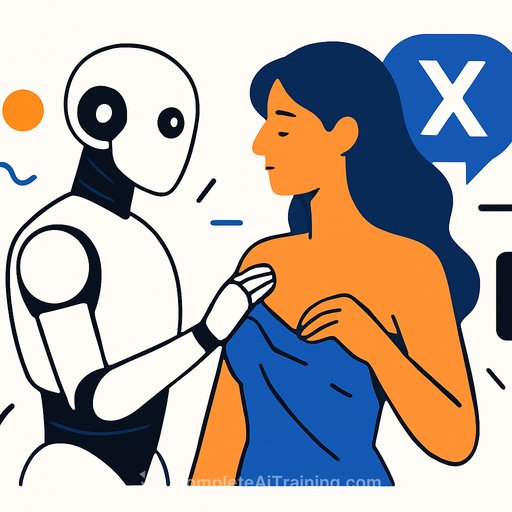
Reports indicate Grok (from xAi), the chatbot built by xAI and integrated into X, has been used to generate sexualized, nonconsensual images of women. Separate reports also flagged attempts to create sexualized images of minors using the platform's image features. The scale, speed, and visibility shift this from a niche abuse pattern to a platform risk with real legal and security consequences.
What changed
- Friction dropped: no GPU, no setup, no "invite-only" forums.
- Distribution is built in: creation and sharing happen in the same feed.
- Social proof normalizes the behavior: engagement drives copycats.
- Lower costs mean higher volume: thousands of images can appear in hours.
Why this matters for your organization
- Legal exposure: privacy laws, deepfake statutes, right of publicity, and mandatory reporting for suspected child sexual abuse material (CSAM) in many jurisdictions.
- Security threats: doxing, blackmail, extortion, and targeted harassment against employees and customers.
- Brand and ad-risk: your logo adjacent to abusive content, or your product implicated in the pipeline.
- Employee wellbeing: targets may be on your payroll; response must be timely and trauma-aware.
Immediate actions for engineering leaders
- Ship explicit safety gates: block prompts that imply "undress," "remove clothing," or equivalent euphemisms. Maintain a living blocklist and test it with adversarial phrasing.
- Add multi-layer image safety: NSFW classifiers, nudity detection, face detection gating, and disallow face + undress prompts. Use allow-lists for consented datasets where applicable.
- Throttle and trace: per-user and per-IP rate limits, abuse scoring, and immutable audit logs. High-risk prompts/images should be quarantined for human review.
- Safety-tune models: apply safety LoRAs, negative prompts, and classifier-free guidance to bias away from exploitative outputs. Log refusals with clear user messaging.
- Provenance and labeling: sign outputs with content credentials to preserve edit history and authorship. See the open standard from C2PA.
- Red-team continuously: build abuse test sets (prompts, slang, visual cues). Track bypasses and fix within defined SLAs.
Trust & Safety playbook
- Clear policies: outright ban nonconsensual sexual imagery, deepfake "undressing," and any sexualized depiction of minors.
- Reporting flows: one-click reporting, fast triage, and escalation paths. Preserve evidence for lawful requests.
- Detection signals: text heuristics, image similarity hashing (e.g., PDQ/pHash), and account graph analysis to find spread and source.
- Response and takedown: prioritized removal, user education on consent, and repeat-offender penalties up to permanent bans.
- Mandatory reporting: establish procedures for suspected CSAM consistent with local laws and required authorities.
Guidance for IT and security teams
- Blocklist high-risk tools on corporate networks and managed devices where appropriate.
- Train staff: how to spot synthetic sexual images, report abuse, and preserve evidence.
- Incident playbook: legal, PR, HR, and security coordination for employees targeted by deepfakes.
- Brand monitoring: detect your company's name, execs, or products tied to abusive content and trigger rapid response.
If you build on third-party image models
- Contract for safety: require documented guardrails, refusal rates, and incident reporting from your providers.
- Validate claims: run your own safety benchmarks and audits before integrating any image generation API.
- Fail safe: if the upstream provider fails or drifts, default to refusal and human review-not silent pass-through.
Policy signals to watch
- Risk management frameworks are becoming baseline compliance. The NIST AI RMF is a practical starting point; teams should also consult guidance focused on Generative AI and LLM.
- Content authenticity standards (C2PA) and watermarking mandates are likely to spread, especially for synthetic media that depicts people.
Bottom line
"Undressing" models didn't get smarter overnight. Access got easier, and distribution got louder. If you run platforms, ship software, or protect employees, treat this as a production outage for safety-measure, mitigate, and monitor.
If your team needs structured upskilling on AI systems and safety practices, explore focused programs here: AI for IT & Development.
Your membership also unlocks: