
AI news ·
Yale medical school teams build AI flashcard and XR anatomy prototypes at second Ideathon
Yale School of Medicine's second Ideathon produced four working AI and extended reality prototypes in a single afternoon. The tools address flashcard generation, clerkship scheduling, anatomy visualization, and clinical communication feedback.
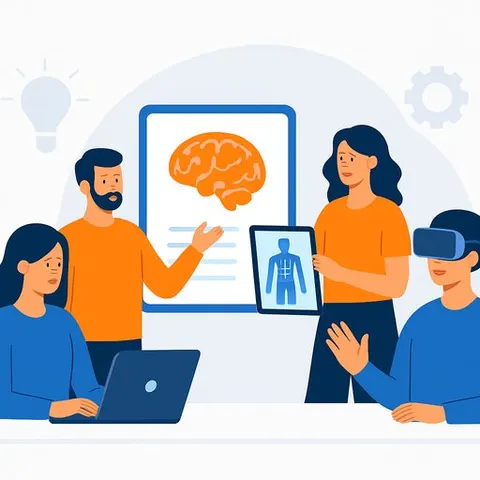
Yale Medical School Teams Build Four Working Prototypes to Improve Medical Education
Yale School of Medicine held its second Ideathon on April 20, where 33 faculty members, staff, students, and residents spent an afternoon building prototypes using AI for Education and extended reality (XR) technology. Four working prototypes emerged from the event, each addressing specific challenges in medical training.
AI-Powered Flashcards From Medical Guidelines
Michail Kokkorakis, a postdoctoral fellow in digestive diseases, built a system that converts lengthy medical specialty guidelines into flashcards using Generative AI and LLM technology.
Medical specialties rely on dense, evidence-based guidelines that students struggle to memorize and recall. Existing flashcard tools like Anki and Quizlet require significant manual setup to create cards from these documents.
Kokkorakis's prototype extracts key recommendations, decision points, drug doses, and diagnostic criteria directly from guideline PDFs. The system generates flashcards tagged by topic and difficulty level, then schedules spaced review sessions to optimize retention. Unlike crowd-sourced flashcard platforms, these cards cite their source directly in the guideline.
Working with Sam Friedman from Yale Center for Research Computing, Kokkorakis created a working prototype during the event. Next steps include comparing the tool's effectiveness against traditional learning methods and conducting a small usability study.
Automated Clerkship Scheduling
Danette Morrison, the medical student clerkship coordinator, presented a scheduling problem that currently requires manual spreadsheet management. Scheduling 20 to 30 students across four three-week rotations while honoring preferences and capacity limits is time-consuming and error-prone.
Morrison's team, working with Tristen Lawrence from ITS Cloud Engineering, built a working PHP prototype in less than an hour during the Ideathon. The scheduler includes a dashboard showing student assignments and rotation choices.
The result: the prototype placed 100% of students in either their first or second rotation choice while evenly distributing students across mandatory rotations over a 12-week schedule. Morrison said the prototype delivers exactly what she envisioned and hopes future scheduling can rely on AI without requiring a software engineer.
Augmented Reality Anatomy and Radiology
Saeed Juggan, an MD-PhD candidate, proposed combining 3D anatomical models with radiology images using Apple Vision Pro headsets. Medical students must learn anatomy, but translating 3D structures to 2D radiology scans remains difficult.
YSM students already use Vision Pro to explore photogrammetry-generated 3D anatomical specimens. Juggan's team is integrating these models with radiology images through the Visage Ease Pro app to help students understand what they see on actual scans.
The team will recruit 20 student volunteers from the Human Anatomy course to test the tool. They will collect qualitative and quantitative data and administer a quiz to measure learning outcomes and knowledge retention.
AI Coaching for Clinical Communication
Darice Corey, senior director for web and IT planning at Yale College, identified a gap in clinical feedback. Medical trainees often receive inconsistent feedback after patient encounters, and feedback typically focuses on clinical accuracy rather than communication skills like empathy and tone.
Corey built a prototype in Replit AI that accepts audio or text transcripts of clinical encounters and provides structured feedback in four areas: clinical reasoning, communication clarity, empathy and tone, and equitable practice.
The prototype allowed the team to test the concept and identify production requirements: encrypted data storage, secure authentication, role-based access, session recording, and progress tracking over time. The tool addresses questions about capturing non-verbal competencies and determining whether feedback should use numeric scores or narrative summaries.