YouTube's AI Double Bind: What Marketers Need to Know for 2026
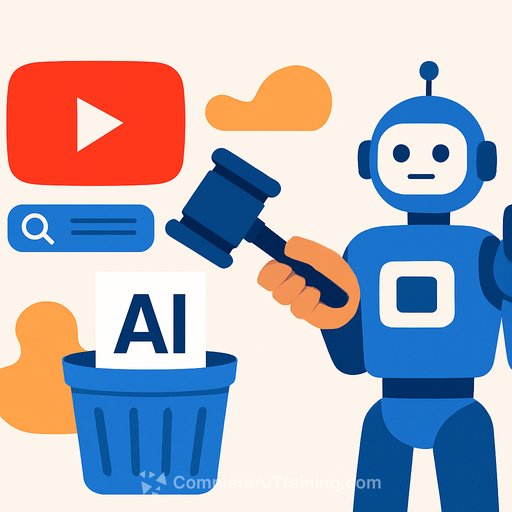
YouTube is sending mixed signals. On one side, it plans to cut low-quality AI content from feeds. On the other, it's rolling out creator tools that use AI to generate Shorts, games, and music.
For marketing teams, this means two things: your AI content will be easier to make and harder to rank. Treat AI like a tool, not a shortcut.
What YouTube says it will reduce
YouTube's CEO signaled a push to limit spam, clickbait, and repetitive, low-value AI output. The goal is to keep viewers' experiences strong and protect time-on-platform.
Translation: thin, auto-generated video farms are on borrowed time. If your workflow leans on templated, recycled outputs, expect reach to decay.
What YouTube is building
At the same time, YouTube is investing in AI-assisted creation. In 2026, expect tools that let creators generate Shorts using AI likenesses, build simple games from text prompts, and access experimental music tools.
Disclosure is mandatory. YouTube will label content made with its in-house tools, and creators must declare if they used external AI. In December 2025, over a million channels used on-platform AI tools, and viewers used YouTube Ask over 20 million times.
The algorithm wildcard
It's unclear whether the algorithm will prefer AI vs. non-AI content, or on-platform tools vs. third-party tools. The company clearly wants less "AI slop," but it's also normalizing AI-assisted creation-especially when it's done on YouTube's rails.
Assume mixed results until proven otherwise. Optimize for watch satisfaction, not just production speed.
Implications for brand and performance
- Brand safety: Avoid generic, repetitive AI video that looks like every other Shorts reel. Viewers are getting better at spotting filler.
- Disclosure discipline: Build a consistent "AI-used" declaration policy now. Don't let compliance sit with creators alone-own it at the brand level.
- Creative mix: Keep human-led strategy and voice. Use AI for drafts, variation, and post-production-then add brand POV, story, and proof.
- On-platform tests: Pilot YouTube's own AI tools for Shorts and music; document how labels affect CTR, comments, and average view duration.
- Differentiation: Use AI to speed iteration, not to homogenize content. Novel angles, useful specifics, and original data will separate you from lookalikes.
- Shorts at scale: AI likeness can multiply presence, but cadence matters. Set frequency caps to prevent fatigue.
- Rights and likeness: Keep legal review in the loop, especially with faces, voices, and soundtrack generation. The company backs the NO FAKES Act; expect stricter enforcement pressure.
- Attribution: Tag AI-assisted videos in your analytics. Track label presence vs. retention and sentiment to see if disclosure changes behavior.
- Creator collaborations: Align on AI usage rules in contracts-what tools are allowed, how likeness is handled, and who approves disclosure.
- Crisis playbook: Prepare takedown and clarification templates if a model outputs something off-brand or infringing.
Practical playbook for Q1-Q3 2026
- Policy and workflow: Create a one-page AI usage policy, a disclosure checklist, and an approval gate for likeness/music features.
- Pilot and measure: Run side-by-side tests-human-only vs. AI-assisted vs. fully AI-with identical topics. Compare watch satisfaction, retention, and unsubscribe rate.
- Creative system: Build a modular script framework (hook, proof, teaching moment, CTA). Use AI to produce A/B variations; humans select final cuts.
- Format bets: Test AI-generated Shorts for FAQs, product explainers, and UGC synthesis - consult resources on Generative Video to refine prompts and pipelines. Keep flagship narratives and brand stories human-led.
- Data standards: Track negative feedback (Not interested, Don't recommend channel), comment sentiment, and watchtime per impression. Scale what viewers reward.
Measurement that actually helps
Don't chase volume for its own sake. Optimize for watch satisfaction, comment quality, and recurring viewers. Those are the signals that protect distribution when policies tighten.
Tag every AI-assisted upload, note whether a label appears, and log tool type (YouTube vs. external). Review outcomes biweekly and cut what creates audience drag.
What to watch next
Keep an eye on how YouTube's labels display, whether AI-assisted content gets special treatment in Shorts, and how aggressive the platform gets on repetitive content. Expect policy clarifications as the new tools roll out.
Upskill your team
If your marketing org needs a clear, practical path for AI in video, start with focused training. These resources can help your team build systems, avoid generic output, and stay compliant:
Your membership also unlocks: