Snap AI Lawsuit: YouTubers Launch Class Action Over Alleged Copyright Use in AI Training
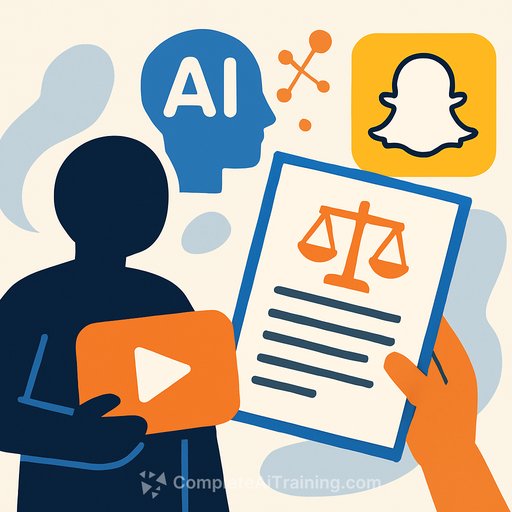
Filed October 13, 2025 in the Central District of California, a coalition of YouTubers has brought a proposed class action against Snap Inc. The complaint claims Snap used their videos to train AI systems-without permission, compensation, or adherence to platform rules.
For counsel advising platforms, AI teams (see AI Learning Path for Data Scientists), or creators, this is a live test of how courts will treat fair use, dataset licensing, anti-circumvention, and the research-versus-commercial line in AI training.
The Core Allegations
- Unauthorized use of YouTube videos from three channels (roughly 6.2 million combined subscribers) to train Snap's AI features, including the "Imagine Lens."
- Reliance on the HD-VILA-100M video-language dataset, allegedly restricted to academic research and not commercial deployment.
- Circumvention of YouTube protections, terms of service, and licensing limits to repurpose videos for AI model development.
Who's Suing and What They Want
Plaintiffs include creators behind h3h3 (about 5.52 million subscribers), MrShortGame Golf, and Golfoholics-spanning different content verticals to bolster class breadth. They seek statutory damages and a permanent injunction to bar Snap from further using their works in AI training.
An injunction is the lever to watch. If granted, it could constrain how Snap-and by extension, other platforms-handle creator content in model pipelines.
Where This Fits in the Larger Fight
- Copyright Alliance reports 70+ AI-related cases as of October 2025.
- Authors vs. Meta: ruled for Meta (text training).
- Authors vs. Anthropic: settlement paid.
- YouTubers vs. Nvidia: active litigation (similar video scraping claims).
The same plaintiffs have sued Nvidia, Meta, and ByteDance-signaling a coordinated approach aimed at industry practices, not a single outlier.
Legal Questions Likely to Drive the Case
- Fair use scope for AI training and downstream features. See 17 U.S.C. §107.
- Use of research datasets in commercial contexts and the weight of dataset license terms (see Research).
- Anti-circumvention claims tied to bypassing technical measures. See 17 U.S.C. §1201.
- Contract and platform-policy theories based on YouTube's ToS and API rules.
- Potential computer-fraud angles if automated access violated statutory or platform restrictions.
The Dataset Angle: HD-VILA-100M
- Scale: ~100 million video clips with text descriptions.
- Sources: Primarily YouTube videos, many under Creative Commons licenses.
- Purpose/Restrictions: Built for academic research; alleged non-commercial limits.
- Scope: Broad categories; multimodal annotations for vision-language tasks.
Plaintiffs allege Snap used the dataset and bypassed YouTube protections to support commercial AI development. If proven, the mix of copyright, contract, and anti-circumvention claims increases litigation exposure.
Industry Responses Taking Shape
- Proactive licensing with media owners and platforms.
- Dataset provenance audits and license verification.
- Clear separation between research and production use.
- Synthetic data exploration to reduce reliance on third-party content.
- Internal standards for scraping, caching, and model training logs.
Practical Checklist for Counsel Advising AI Teams
- Inventory all training datasets; map licenses, permissions, and usage restrictions.
- Document data lineage and maintain reproducible training records.
- Gatekeep "research-only" datasets from commercial paths; enforce access controls.
- Honor platform ToS, robots.txt, and API rate/usage limits; review vendor practices.
- Develop takedown and remediation workflows for rights-holder complaints.
- Assess fair use positions early; consider opt-out, licensing, or filtering mechanisms.
- Run periodic legal/engineering audits on scraping tools and model inputs.
Historical Threads Courts May Pull From
- Music sampling disputes (transformative use and licensing norms).
- Image search thumbnails and display rights.
- News aggregation and copying of expressive elements.
- Software reverse engineering for interoperability.
AI training adds scale and opacity. Courts must decide how those differences matter when applying established doctrines.
What's at Stake
- Creators: Clearer rights, potential compensation models, and stronger say over data use.
- AI companies: Compliance costs, licensing frameworks, and more rigorous data governance.
- Platforms: Tighter technical controls, updated terms, and possible changes to API access.
This case will sit alongside other rulings to define the boundaries of lawful AI training. Expect close scrutiny of how content moves from public platforms into commercial models-and whether that path is legally sound.
FAQs
Q1: Which Snap feature is at issue?
The complaint points to Snap's "Imagine Lens," which edits images using text prompts. Plaintiffs allege it benefited from training on their copyrighted YouTube content.
Q2: How many AI copyright cases are on record?
According to the Copyright Alliance, 70+ cases were filed against AI companies as of October 2025.
Q3: What dataset is allegedly involved?
HD-VILA-100M-a large video-language dataset originally intended for academic research, not commercial deployment.
Q4: Who else have these YouTubers sued?
Nvidia, Meta, and ByteDance, indicating a coordinated strategy across multiple platforms.
Q5: What relief do plaintiffs seek?
Statutory damages and a permanent injunction barring further use of their content in Snap's AI training.
Your membership also unlocks: