Zambia's Executive AI Briefing: A Practical Path to Enterprise Adoption in 2025
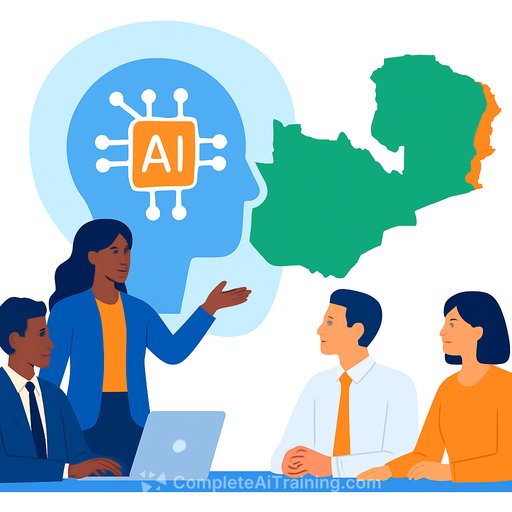
Zambia moved forward on enterprise AI adoption with an Executive Artificial Intelligence Briefing on Dec. 16, 2025, hosted by the Ministry of Technology and Science in partnership with Pranary. Thirty senior decision-makers met for a focused session on deploying AI at scale in 2025.
The goal was simple: give C-suite leaders practical roadmaps, governance frameworks and leadership insights that align with the country's digital transformation agenda. The message was clear-AI is now a business priority, not a side project.
Why AI is treated like an essential utility
Minister of Technology and Science Felix Chipota Mutati called AI a national imperative, comparing its importance to electricity. He underscored that AI delivers value without requiring deep technical expertise to use-but it does require strong leadership, adequate infrastructure and a mindset shift.
His stance: AI should amplify human judgment, not replace it. Wisdom, decision-making and ethics stay human.
Four enablers for Zambia's enterprise AI adoption
- Digital infrastructure: Reliable connectivity, data platforms and secure systems.
- Energy reliability: Consistent power to support data centers, devices and compute.
- Continuous skills development: Ongoing upskilling across functions, not just tech teams.
- Trust, collaboration and governance: Clear rules, transparency and cross-sector coordination.
Leadership is the make-or-break variable
Dr. Lelemba Phiri, director at ATG, highlighted that more than 70% of digital transformation efforts fail due to organisational readiness and leadership gaps-not technology. AI marks the biggest workplace shift since the internet, and misaligned leadership behavior often derails strategy.
Skills now have a shelf life of three to five years, which makes continuous learning non-negotiable. Leaders must go first and model adoption.
- Visible executive use of AI in daily work and decision-making.
- Shift to output-based performance metrics over activity-based measures.
- Psychological safety so teams can test, learn and ship improvements.
- Institutionalised learning: internal academies, peer labs, communities of practice.
- Rewards for efficiency, cost savings and innovation-not just effort.
From IT project to business transformation
Pranary CEO Sandras Phiri urged leaders to treat AI as a business transformation initiative. Zambia can skip slow, legacy digitisation and move to agentic and generative AI systems that create measurable value in weeks.
The untapped asset is proprietary data across mining, finance, insurance and public administration. To use it well, executive ownership and strong governance are essential.
Readiness first: what every executive should assess
- Governance: Clear policies on data use, privacy, model risk and security, aligned to standards like the NIST AI Risk Management Framework and OECD AI Principles.
- Executive accountability: Named owners for outcomes, not just oversight committees.
- Strategic clarity: Top 3 value use cases by function with defined ROI and timelines.
- Data advantage: Access, quality, labeling, and pipelines for proprietary data.
- Risk posture: Controls for shadow AI and unapproved tools; clear vendor policy.
90-day action plan for C-suites
- Stand up an AI steering group led by a business owner and supported by IT, data, legal and risk.
- Select 2-3 high-impact pilots (e.g., underwriting triage, mine maintenance scheduling, citizen services routing) with weekly metrics.
- Create a lightweight AI policy: approved tools, data classifications, human-in-the-loop, audit logs.
- Launch an internal learning sprint for executives and managers; require hands-on AI use in reviews.
- Map critical data assets and set up secure access patterns and monitoring.
What this means for Zambia's growth
Participants agreed: AI is no longer optional. With people-centered adoption, strong governance and clear executive ownership, AI can drive productivity, resilience and inclusive growth across the economy.
The focus now is execution-skills, infrastructure and policies that enable scale. Leaders who move first will set the standard for value, trust and speed.
Resources for leaders
Your membership also unlocks: