ZENN: An AI framework that learns from messy, mixed-quality data
AI is embedded in modern research, but most models stumble once data depart from neat assumptions. Instruments disagree, experiments vary, simulations are cleaner than sensors - and typical training pipelines pretend those gaps don't exist. For additional context on developments in the field, see AI Research.
Researchers at Penn State introduced a framework that faces this head-on. It's called ZENN - short for Zentropy-Embedded Neural Networks - and it teaches models to detect and adapt to differences in data quality instead of glossing over them.
The core idea
ZENN builds thermodynamics into neural networks. It separates what's meaningful in the data (energy) from what's uncertain or noisy (intrinsic entropy), and uses a tunable "temperature" parameter to account for hidden differences across datasets - for example, precise simulations versus noisier experiments.
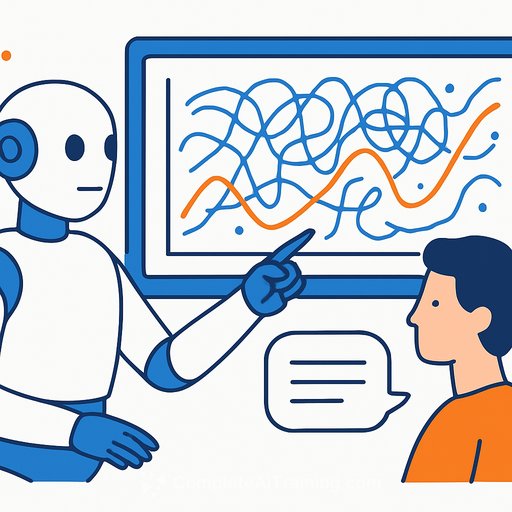
Think of reading a smudged, handwritten note. You intuit what's a real letter and what's a stain. ZENN gives AI that same instinct.
Who built it and why "Zentropy" matters
The framework was developed by Shun Wang (mathematics), Wenrui Hao (mathematics; Center for Mathematical Biology), Zi-Kui Liu (materials science and engineering) and Shunli Shang (materials science and engineering). It is grounded in Liu's Zentropy theory - a deeper take on entropy that unifies quantum mechanics, thermodynamics and statistical mechanics into a predictive model.
Instead of assuming all observations are equally reliable, ZENN encodes uncertainty where it belongs and preserves signal where it exists. That shift matters for any lab juggling hybrid datasets.
Why it's useful for researchers
- Works with heterogeneous data. Images, text, geospatial inputs and more can be mapped into a shared representation without forcing false uniformity.
- Bridges simulation and experiment. The model can learn different "temperatures" for clean simulated outputs and noisier experimental measurements, calibrating trust automatically.
- Stays dependable when data quality varies. In tests, ZENN matched larger models while remaining more consistent across mixed inputs - and it offers insight into why a system behaves the way it does.
Featured study and an early case
The study was highlighted as a showcase in the Proceedings of the National Academy of Sciences. For context on the journal, see PNAS.
In a materials science test, the team analyzed an iron-rich iron-platinum alloy that contracts when heated (negative thermal expansion). ZENN helped reconstruct the material's free-energy landscape, clarifying the thermodynamic mechanisms behind that unusual behavior.
Where ZENN can make a difference
- Alzheimer's and other complex diseases: integrate MRI, genetics, molecular markers and clinical records to identify subtypes, track progression and flag key transition points.
- Cryo-EM of amyloids: combine variable-resolution images and analysis pipelines without flattening uncertainty.
- Climate research: fuse fossil pollen grain analyses with environmental records and models.
- Geospatial + sensor stacks: align GIS layers with PM2.5, housing price and mental health indicators for cleaner inference.
- Materials design: learn from both simulations and experiments to suggest candidates that are promising and manufacturable.
- Quantum computing: treat uncertainty as a feature to interpret and manage quantum information more effectively.
How it differs from standard training
Conventional neural networks often rely on cross-entropy loss and assume tidy, consistent training sets. That assumption breaks down with heterogeneous inputs. ZENN's thermodynamics-inspired split - signal (energy) versus uncertainty (intrinsic entropy) - plus a dataset-aware temperature term, lets the model pick out what matters and discount what doesn't, source by source.
Interpretable by design
Many AI systems act like black boxes. ZENN provides knobs and quantities that map to physical intuition, making it easier to ask not just "what" will happen, but "why." That's the kind of feedback loop labs need for mechanism-driven discovery, not just pattern matching.
Limits and next steps
Scaling to extremely large or intricate systems remains a challenge. Even so, the approach points to a broader shift: embedding scientific principles directly into learning so models respect how data are produced and where uncertainty comes from.
Team, support and collaborations
The work spans mathematics, materials science and life sciences at Penn State, with collaborations forming across multiple disciplines. Funding came from the U.S. National Institute of General Medical Sciences and the U.S. Department of Energy, along with the Endowed Dorothy Pate Enright Professorship. Learn more about NIGMS here.
A quick mental model of the visual
Picture a flowing, multicolored surface that captures hidden patterns across many data types. Icons for images, text and location feed into this shared surface. ZENN treats that surface as a unified picture - isolating real signal while acknowledging different levels of noise across sources.
Keep your AI skills sharp
If you're building or evaluating scientific AI systems and want structured learning paths, explore the AI Learning Path for Data Scientists.
Your membership also unlocks: