AI agent for sustainability analysts
Life Cycle Inventory Data Gap Agent
Close or document every material data gap and show how it affects the result.
What it does
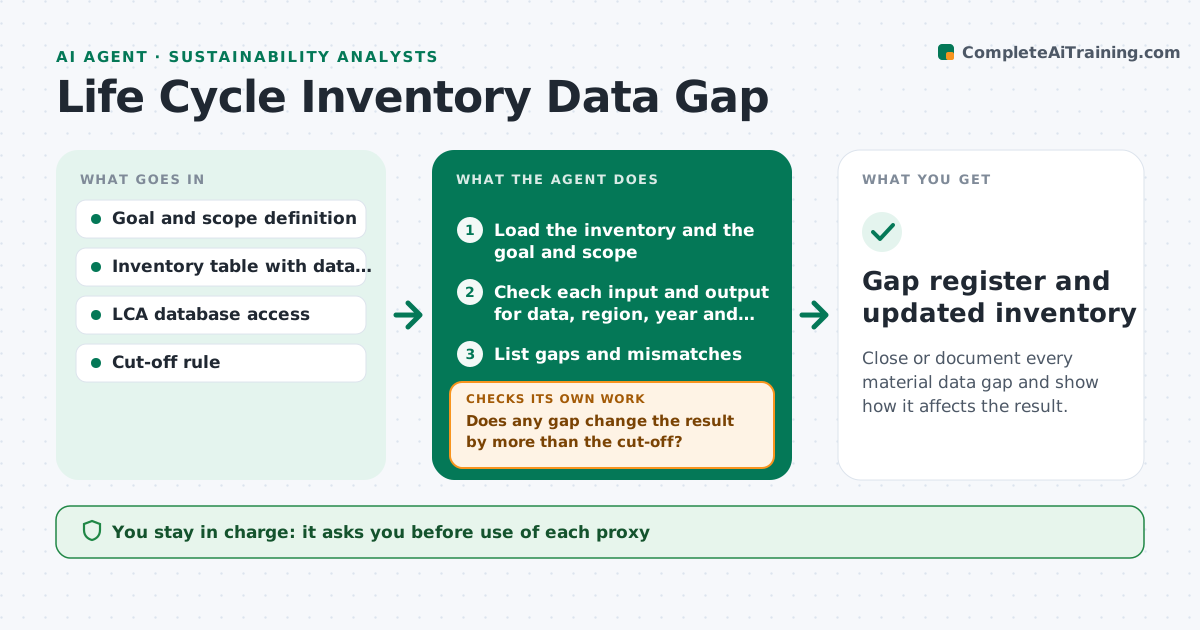
A life cycle assessment study often finds, late, that some inputs have no data or that datasets use different boundaries, so the results are not comparable. This agent lists every input and output in the product system and checks each against the goal and scope: the functional unit, system boundary and cut-off rule. It flags items with no data, data from a different region or year, and data that covers a different boundary. For each gap it searches for a proxy dataset and scores how well it fits. It then tests how much each gap or proxy changes the result by varying it, and reruns the model. It focuses effort on the gaps that matter. It never adopts a proxy by itself. The analyst approves. Edge case: a gap below the cut-off rule is documented, not filled.
How it works
Follow the arrows from top to bottom. The orange dashed arrow is the loop: when a check fails, the agent goes back and tries again.
Read the steps as a list
- Inventory built or changed
- Load the inventory and the goal and scope
- Check each input and output for data, region, year and boundary
- List gaps and mismatches
- Search databases for proxy datasets and score fit
- Run the model with each proxy and with high and low values
- Does any gap change the result by more than the cut-off?If not: document the gap as immaterial and keep the proxy note. Back to step 5.
- Is the proxy fit good enough for each material gap?If not: search for a better dataset or request primary data. Back to step 4.
- Write the data gap report with sensitivity results
- Analyst approves proxies and documented gapsThe agent waits here for your OK.
- Gap register and updated inventory
How it decides
It ranks gaps by their effect on the result in a sensitivity test, and treats a gap as material when varying it changes the result by more than the cut-off.
- Treat a gap as material when it changes the result by over 1%
- Prefer data of the same region and year
- Do not fill gaps below the cut-off, only document them
- Ask for primary data when no proxy scores well
Make it yours
Every agent is a starting point. You choose these settings for your own situation.
- Materiality threshold (default 1%)
- Variation range for tests
- Databases to search
- Cut-off rule
- Report format
What keeps you in control
It always asks you first
- Use of each proxy
- Documented immaterial gaps
Hard limits
- Never replace data without a recorded reason
- Document every proxy with its source
It stops when
- Done: all material gaps closed or approved
- Stop: no suitable proxy and no primary data
Set it up
We guide you through the set-up, step by step
Members get the full set-up guide for this agent. No technical skills needed: you copy, paste and upload.
- One set of instructions to paste into your AI, with the clicks for ChatGPT, Claude, Microsoft 365 Copilot, Gemini and Grok
- The agent then walks you through connecting your own data, one source at a time
- A downloadable copy with the flow chart, the rules and the full guide