AI agent for data architects
Technology Option Evaluation Agent
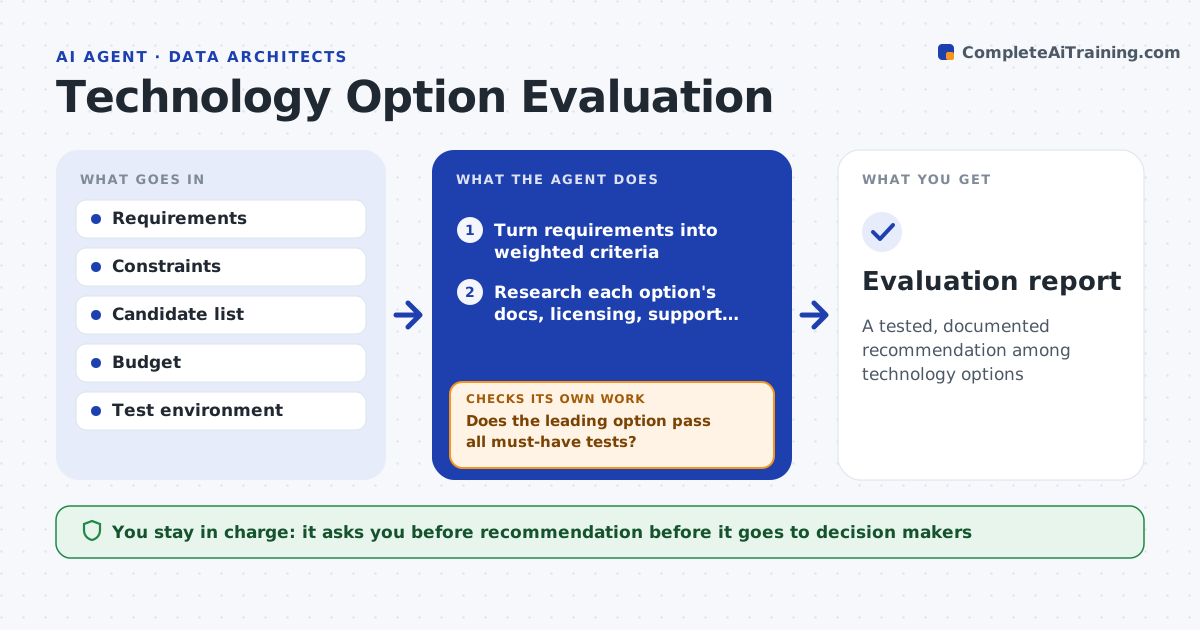
A tested, documented recommendation among technology options
What it does
Choosing a database, framework or software package means comparing options against real requirements, not vendor marketing. When an evaluation is requested, this agent turns the requirements into weighted criteria, with must-haves as simple pass or fail. It researches each option's documentation, licensing, support and known limits, and includes total cost over three years. It scores the options and picks the top two. For those it prepares a small proof of concept test plan and records the results the team runs. If the leading option fails a must-have test, it drops that option, moves the next one up and tests it. It drafts an evaluation report with the recommendation. The architect or analyst approves it before it goes to decision makers. Edge case: a license change announced recently is flagged even when the current version is still fine.
How it works
Follow the arrows from top to bottom. The orange dashed arrow is the loop: when a check fails, the agent goes back and tries again.
Read the steps as a list
- Evaluation requested
- Turn requirements into weighted criteria
- Research each option's docs, licensing, support and limits
- Score options and pick top two
- Run or record proof of concept tests
- Does the leading option pass all must-have tests?If not: drop the option, promote the next one, and test it. Back to step 4.
- Draft evaluation report
- Architect or analyst approves the recommendationThe agent waits here for your OK.
- Evaluation report
How it decides
Options must pass all must-have criteria; remaining options are ranked by weighted score and proof of concept results.
- Must-haves are pass or fail
- Recent license changes are flagged
- Total cost over three years is included
Make it yours
Every agent is a starting point. You choose these settings for your own situation.
- Criteria and weights
- Proof of concept scope
- Cost horizon (default 3 years)
- Report template
What keeps you in control
It always asks you first
- Recommendation before it goes to decision makers
- Any vendor contact or trial signup
Hard limits
- Never signs up for paid trials
- Never contacts vendors without approval
It stops when
- Done: approved recommendation
- Stop: no option passes must-haves, report the gap
Set it up
We guide you through the set-up, step by step
Members get the full set-up guide for this agent. No technical skills needed: you copy, paste and upload.
- One set of instructions to paste into your AI, with the clicks for ChatGPT, Claude, Microsoft 365 Copilot, Gemini and Grok
- The agent then walks you through connecting your own data, one source at a time
- A downloadable copy with the flow chart, the rules and the full guide