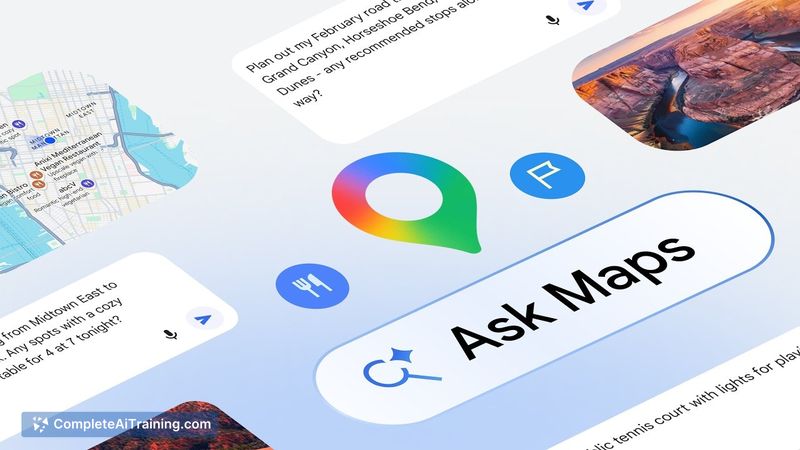
About Ask Maps by Google
Ask Maps by Google adds a conversational layer to map search, letting users ask complex, real-world questions about places and receive personalized answers. It combines place data and contributor insights with a new Immersive Navigation mode to provide contextual suggestions and richer route visuals.
Review
Ask Maps introduces conversational queries directly into the map experience, so you can ask where to charge your phone, find a tennis court at night, or plan stops on a road trip without switching tabs. The feature pairs personalized place recommendations with vivid 3D route views that highlight lanes, landmarks, traffic lights, and give more natural voice guidance.
Key Features
- Conversational place queries that return personalized recommendations and map highlights.
- Leverages large place datasets and contributor insights to surface options and details for real-world questions.
- Immersive Navigation with 3D route rendering, lane and landmark highlights, and clearer voice guidance for turns, merges, and exits.
- In-map actions such as booking, saving, and starting navigation directly from query results.
- Initial rollout with availability in select regions, enabling early access for many users through the existing maps app.
Pricing and Value
At launch, Ask Maps is available as part of the existing maps experience with free access for users in supported regions. The value proposition centers on saving time and reducing friction by answering multi-step, location-based questions in a single conversational flow and by providing clearer visual guidance while driving. Business or premium pricing has not been announced; users should expect the feature to follow the same update and availability model as the core maps application.
Pros
- Makes complex, context-dependent place searches simpler with conversational input.
- Immersive Navigation offers clearer visual cues for lane changes, merges, and important landmarks.
- Direct actions from results (booking, saving, navigating) reduce steps between discovery and action.
- Leverages large datasets and contributor content to provide detailed place information.
Cons
- Initial availability is limited to selected regions, so many users will wait for wider rollout.
- Subjective queries (for example, "best quiet café for working") may still produce mixed or ambiguous results depending on review signals and data coverage.
- Higher reliance on online data and location signals means functionality can vary with connectivity and local data freshness.
Ask Maps is best suited for drivers, travelers, and anyone who prefers conversational search to find or act on place information quickly. Users who value clearer in-route visuals and fewer taps to book or save locations will benefit most, while those outside supported regions or who need consistently precise subjective recommendations may want to wait for broader availability and further refinement.
Open 'Ask Maps by Google' Website
Your membership also unlocks: