About Atoms
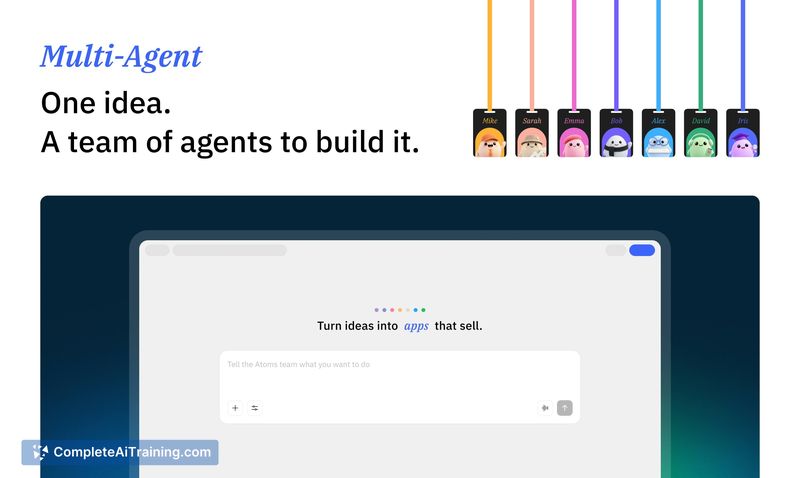
Atoms is an AI-driven service that aims to turn raw ideas into revenue-generating web products. It runs a multi-agent workflow that researches markets, designs UX, writes frontend and backend code, integrates authentication and payments, and ships a live app rather than just a prototype.
Review
Atoms positions itself as the first "vibe business team" that compresses an entire product team into an AI-native workflow. The platform combines specialist agents and a Team Lead agent to take projects through research, build, launch, and early-growth activities, with explicit checkpoints and parallel proposal modes.
Key Features
- End-to-end product pipeline: research → design → build → launch → traffic → revenue, aiming to deliver chargeable live apps.
- Multi-agent architecture with a Team Lead agent plus specialist agents for product, engineering, SEO, and analytics, including a "Race Mode" to compare options.
- Automated integrations for common authentication and payment workflows, with a public example of a user spending about $4 to launch an AI image site with signup and payments.
- Built on a mix of models and tools (Claude for long-context reasoning, DeepSeek for code and reasoning, Gemini 2.5 for multimodal research, and OpenAI for planning and code generation).
- Focus on launch-readiness and early monetization, with traceable decisions and surfaced trade-offs for user approval.
Pricing and Value
Public details on full pricing tiers are limited; the product page notes free options and highlights low-cost experiments (an example build costing roughly $4). Value for users will depend on the extent of automation they need, frequency of builds, and third-party costs (hosting, APIs, payment processor fees). Potential pricing models implied by the offering include a free tier or trial, pay-per-build or per-project fees, and subscription plans for ongoing use or higher-volume needs. For teams that need rapid end-to-end prototypes that can be billed to users, the platform aims to shorten time-to-first-customer and reduce upfront engineering effort.
Pros
- Ambitious end-to-end scope that includes distribution and monetization, not just code generation.
- Clear process controls: checkpoints, assumption traces, and parallel proposals to compare trade-offs.
- Mixes multiple model backends to balance long-context reasoning, code generation, and multimodal research.
- Practical automation for common auth and payments paths, reducing manual wiring for typical stacks.
Cons
- Still early-stage publicly: case studies and long-term reliability data are limited.
- Complex or unusual auth/payment setups and edge-case infrastructure may require manual intervention or extra engineering.
- Dependence on multiple external model providers and third-party services can introduce variability in cost and behavior.
Atoms is best suited for makers, solo founders, and small teams who want to validate ideas quickly with a live, billable product and prefer to offload much of the product/engineering pipeline to an automated team. It can accelerate early validation and reduce initial engineering overhead, but teams with highly customized infrastructure or strict compliance needs should plan for manual checks and integrations.
Open 'Atoms' Website
Your membership also unlocks: