AI tool
BackEngine MCP
BackEngine MCP applies helpdesk permission rules to AI-generated responses, ensuring internal notes stay internal and public replies only draw on shareable data. It is built for support teams whose AI assistants ground answers on full customer rec...

About BackEngine MCP
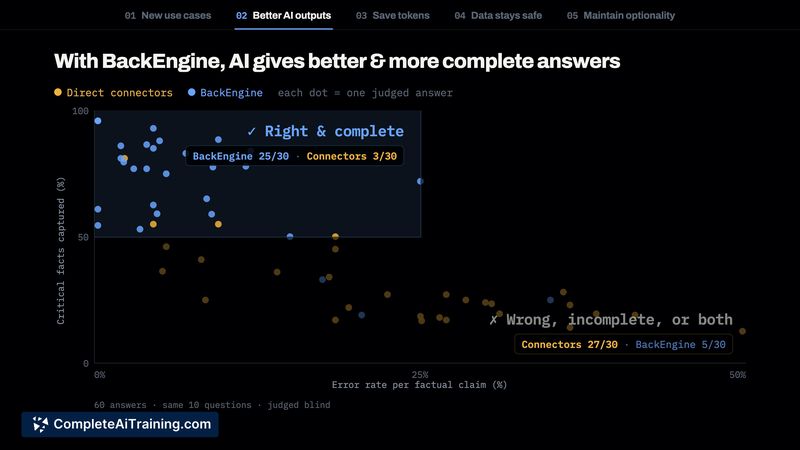
BackEngine MCP is an AI infrastructure tool that connects to a company's existing communication and CRM systems-Slack, email, calls, tickets-and pre-processes that unstructured data into a single permissioned record per account. It launched this week and is built around the Model Context Protocol, letting Claude, ChatGPT, or other LLMs query that joined record instead of reading raw slices from each source independently. The tool's own benchmark study reports 67% fewer errors, 2.4x more key facts, and 65% fewer tokens compared to direct connectors into the same systems.
Review

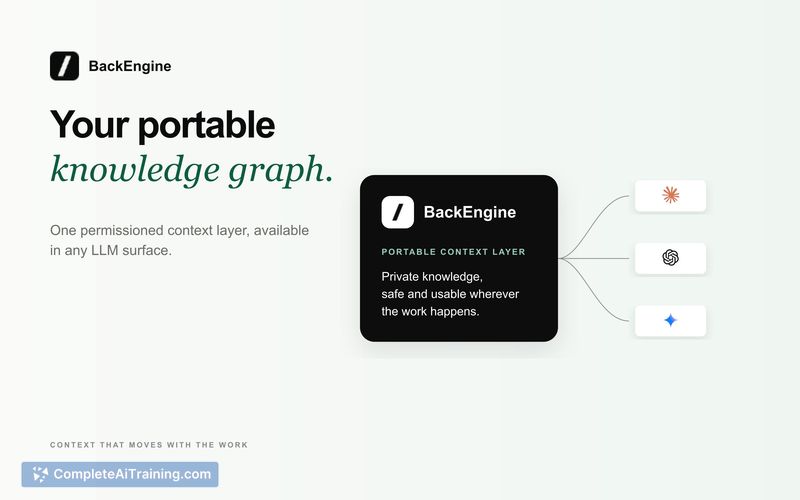
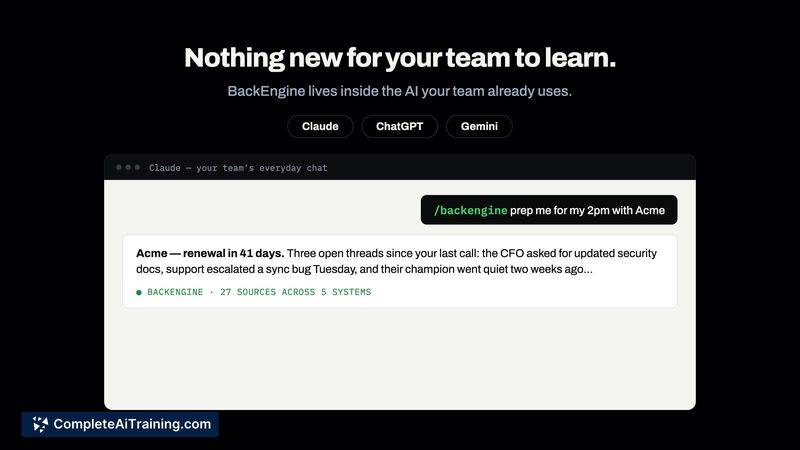
Most MCP setups wire an LLM directly into Slack, email, and a CRM, which means the model reads fragments and fills in the gaps on its own. BackEngine takes a different path: it ingests everything first, joins it into one record per account, and keeps that record current so the model works from a complete picture. The distinction matters for teams that rely on AI for customer-facing work, where a missing ticket or a stale transcript can change an answer entirely.
The product is fresh on the market, and the public conversation around it already surfaces some real design tensions. The team addresses those head-on, which is useful for evaluating whether the architecture fits your workflow.
Key Features
- Unified account record: conversations from calls, emails, Slack, tickets, and support history are joined into one permissioned record per customer account, with each claim linked back to its source, date, and author.
- Pre-processing before query: data is read and structured before anyone asks a question, so the LLM works from a consolidated context rather than querying each system live.
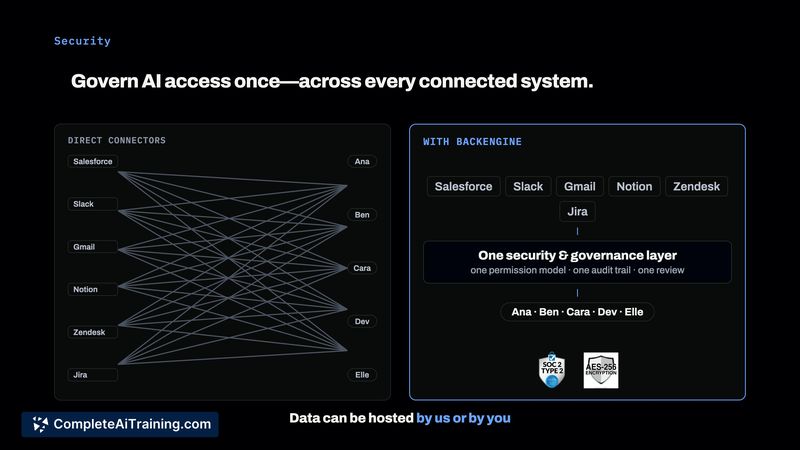
- Tiered permissions: account access is either open company-wide or locked to named individuals and groups; depth of visibility is configurable, so a user can see a takeaway from a conversation without the raw transcript.
- Source labeling: every returned line carries provenance labels indicating who said it and where it came from, which keeps internal notes separate from customer-facing content.
- Model portability: the knowledge layer sits outside any single LLM, so teams can switch between Claude, ChatGPT, or other models without losing accumulated context.
Pricing and Value
Pricing is not yet defined on the public launch page. The listing includes a "Free Options" tag, but no specific tiers or costs are stated. The value argument rests on the benchmark study published at backengine.com/benchmark, which reports token reductions of 65-89% for the same cross-functional business questions compared to direct connectors, and factual accuracy of 99% versus 66.2% with direct connectors. Teams considering the tool will need to contact the makers directly for commercial terms.
Pros
- Reduces token consumption substantially for complex cross-functional questions, which translates directly into lower LLM operating costs at scale.
- Permissioning is granular: you can block specific employees or teams from an account, redact data types on the way in, and limit users to summaries without raw text.
- Webhook-based ingestion brings most sources in within minutes, and the system flags potential gaps to the model when scheduled sources lag by a few hours.
- Source-linked claims let users trace any answer back to the original email, call, or ticket, which builds a verifiable audit trail.
Cons
- Freshness is not fully deterministic: some sources are polled on a schedule and can be hours behind, and the gap notice goes to the model rather than to the user, so whether a stale source gets re-fetched is the model's discretionary call at query time.
- Summarization can strip provenance: when multiple labeled lines are condensed into a single takeaway, the resulting sentence has no source attached, and that takeaway is the artifact most likely to be pasted elsewhere.
- The tool is not well suited for teams that need real-time answers from sources with API rate limits or for organizations that require a human-visible freshness stamp on every response, since that capability is not currently exposed.
BackEngine MCP fits teams that run customer-facing AI workflows across multiple communication channels and want a consolidated, permissioned context layer rather than a pile of raw connectors. It's most useful for revenue operations, customer success, and support functions where call prep, renewal risk, and product feedback depend on the full account story. Teams with strict requirements around data freshness transparency or those that need to audit every summarization step may find the current gaps limiting until the roadmap addresses them.
Jobs BackEngine MCP suits
We checked BackEngine MCP against 500+ jobs; these get the most out of it.