About Bibby AI
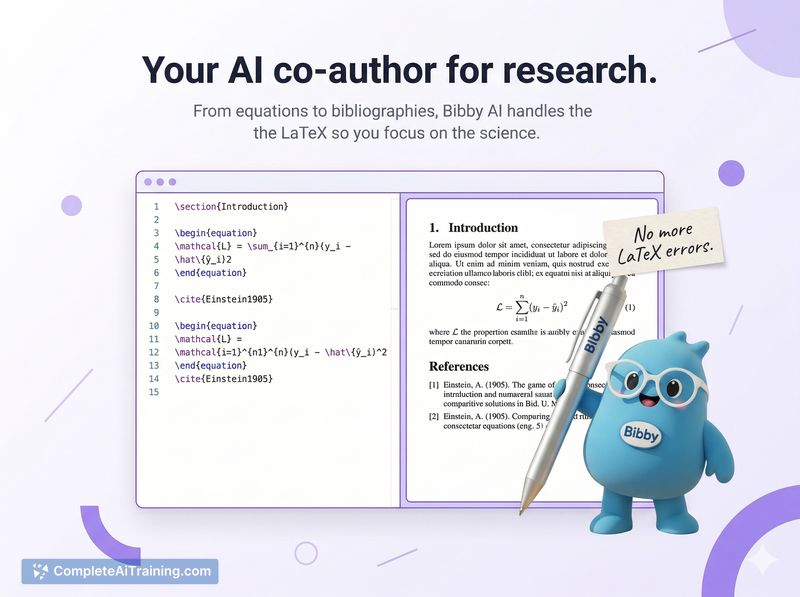
Bibby AI is an AI co-author built to help researchers write and refine academic papers. It searches literature, inserts citations, formats equations, and offers in-context writing assistance so researchers can focus more on ideas and less on formatting and citation chores.
Review
This review looks at Bibby AI's core capabilities, usability, and suitability for different research workflows. I cover key features, pricing cues from the product page, strengths and limitations, and who will benefit most from the tool.
Key Features
- Context-aware autocomplete and in-line editing that uses your full paper as context to suggest relevant continuations and rewrites.
- Extensive citation support with a large indexed corpus (200M+ citations) and tools to add references with one click.
- Photo-to-equation conversion that converts photographed or handwritten equations into formatted math, plus LaTeX error detection and one-click fixes.
- Deep research mode that finds sources, traces citation trails, spots gaps, and can generate literature reviews or abstracts from your manuscript.
- Collaboration and workflow features: real-time team editing, version history with visual diffs, GitHub sync with automated commit messages, and many publisher-approved templates.
Pricing and Value
The product page highlights free options and a launch discount (for example, a 40% off launch offer). Exact subscription tiers and enterprise pricing are not detailed on the page, so potential users should check the official site for current plans. From the listed capabilities, the tool's value is strongest for users who frequently prepare manuscripts, manage citations, and handle repeated formatting or LaTeX issues-features that can save hours in the writing and submission cycle.
Pros
- Focuses on academic workflows: citation insertion, literature tracing, templates and reviewer-style feedback aimed at research papers.
- Large citation index and citation-tracing features help expose upstream sources and conflicting findings that papers often miss.
- Strong LaTeX support: internal benchmarking shows high detection and one-click fix rates for compilation errors, reducing time spent troubleshooting.
- Privacy promise that your research is not used to train the product's models, which is important for unpublished work.
- Convenient features like photo-to-equation and abstract generation can accelerate drafting and formatting tasks.
Cons
- Interdisciplinary or highly novel topics can still pose challenges; the tool may require human oversight to reconcile conflicting sources and argumentation.
- Team suggestion preferences are currently global rather than per-author, which can complicate multi-author workflows with differing styles.
- Detailed pricing and some enterprise features require visiting the website or contacting sales, so upfront cost clarity is limited from the product page alone.
Overall, Bibby AI is best suited for graduate students, postdocs, principal investigators, and research teams who spend significant time preparing manuscripts, troubleshooting LaTeX, and managing citations. It's most useful where time savings on formatting, citation management, and iterative drafts translate directly into more research time and fewer submission delays.
Open 'Bibby AI' Website
Your membership also unlocks: