About Cortex by SKYNETLAB
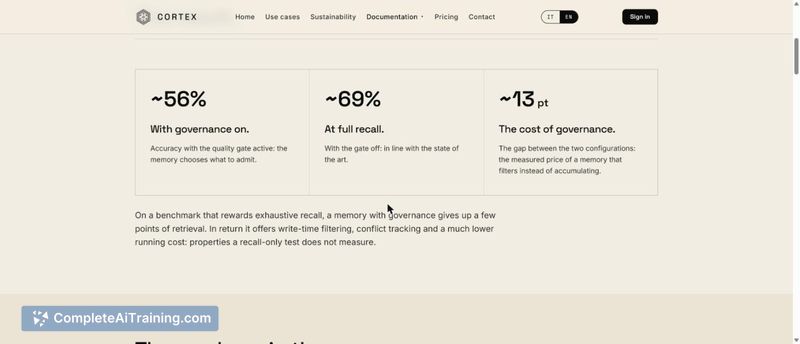
Cortex by SKYNETLAB is a hosted semantic memory service that AI assistants connect to over the Model Context Protocol (MCP). It was launched this week by a solo developer in Bergamo, Italy, and operates on EU infrastructure. The core idea is that every memory write passes a quality gate before it's stored, with roughly 80% of writes rejected as redundant in production.
Review
Cortex addresses a specific problem: AI conversations start from zero every time, and the common fix of dumping transcripts into a vector store fills up with junk and contradictions. Instead of storing everything, Cortex filters writes through a quality gate and stores facts as typed claims. Contradictions are tracked as separate objects rather than overwritten, and answers can cite their sources.
Key Features
- Quality gate on writes: each memory submission is evaluated, and redundant writes are rejected with a synchronous response containing the verdict, reason, and the ID of the closest existing memory.
- Typed claims: facts are extracted and stored as typed claims rather than free-form text, which gives structure to what the AI remembers.
- Contradiction tracking: conflicting information is stored as a first-class object instead of overwriting the previous fact, so the system tracks both sides.
- Source citation: answers can show where their information came from, so the AI can prove why it said something.
- Reject log: every rejected write leaves a row with timestamp, reason, which gate rejected it, and the nearest existing memory. This is queryable via GET /brain/rejects with 30-day retention. No payloads are stored for rejected writes.
Pricing and Value
Cortex runs a 30-day free trial that doesn't require a credit card. Paid plans start at €0.99 per month. Rejected writes don't consume quota, so the filtering also reduces cost. The pricing model is simple: you pay for what passes the gate, not for every attempt. The service runs on EU infrastructure and uses a patent-pending engine.
Pros
- Rejection is transparent: the write call returns a verdict and reason immediately, so callers know at write time rather than discovering gaps later.
- Duplicates corroborate instead of vanishing: when the gate identifies a duplicate, the existing memory's corroboration counter increments, which raises its trust score.
- Works with Claude in about 2 minutes as a custom MCP connector, and functions with any MCP client.
- The reject log shipped the same day a user requested it, which shows the developer responds to feedback quickly.
- No card required for the trial period, and the entry price is low.
Cons
- No stored archive of rejected payloads exists; only a lightweight log with reasons and nearest matches is kept, so you can't review the full content of what was rejected.
- The reject rate isn't surfaced as a visible metric yet; a user suggested showing it as a number, but that feature hasn't shipped.
- Cortex isn't well suited for teams that need on-premise deployment or non-EU data residency, since the infrastructure is EU-based and there's no mention of self-hosting options.
Cortex suits developers building AI assistants that need persistent, structured memory with auditable sources. It's particularly relevant for solo builders or small teams who want a hosted memory layer without running their own infrastructure. The tool is new, so its long-term reliability and the solo developer's capacity for support are worth monitoring.
Open 'Cortex by SKYNETLAB' Website
Your membership also unlocks: