About Edit Mind × Strava
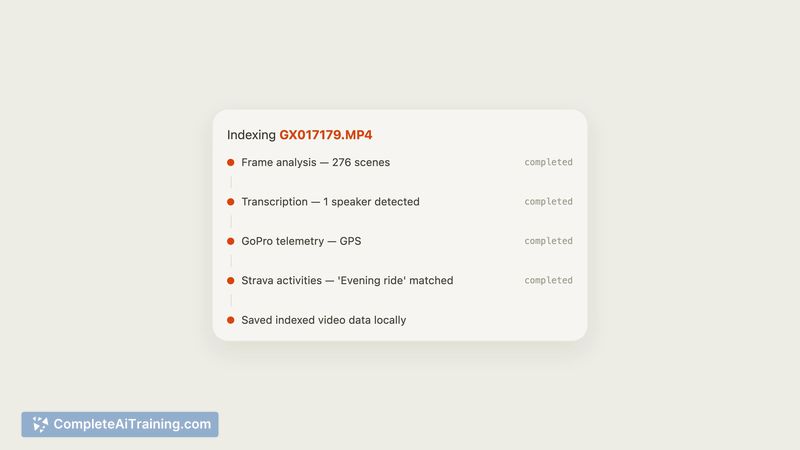
Edit Mind is a local video search tool that indexes footage and allows natural language queries without uploading files to the cloud. The Strava integration extends this by matching every scene in a user's footage to the corresponding Strava activity. Heart rate, speed, elevation, and distance data are aligned to the video frame, using GPS telemetry from action cameras for exact matching or file creation timestamps for phone footage.
Review
The Edit Mind × Strava integration brings a narrow but practical capability to cyclists, runners, and other athletes who film their activities. Footage and ride metrics are merged on the local machine so nothing leaves the device, and the natural language search accepts queries that reference Strava stats-for example, "moments where speed went above 50 km/h" or "clips during a personal record segment." The tool handles multiple activities in one video file, splitting the footage correctly between a bike ride and a run if both are logged to Strava.
Key Features
- Frame-level matching of video to Strava activity data points: heart rate, speed, elevation, and distance.
- 100% local operation; footage stays on the user's computer with no cloud processing.
- Natural language search using Strava metrics, such as "peak heart rate" or "fastest mile."
- GPS-based alignment for action cameras (GoPro) and creation-date fallback for phone videos.
- Audio transcription search built into Edit Mind, which detects spoken words and sounds like laughing or clapping.
Pricing and Value
Pricing for Edit Mind and the Strava integration has not been announced. The usefulness to a user hinges on how frequently they record video during Strava-tracked activities and whether they need to locate clips by performance data rather than manually scrubbing through footage.
Pros
- Runs entirely on the user's machine, avoiding cloud uploads and keeping sensitive ride data local.
- Pairs arbitrary video frames with granular Strava telemetry, so a clip isn't just a timestamp-it carries ride context.
- Supports conversational search filters that reference recorded metrics, which can save time when pulling highlight moments.
- GPS telemetry from action cameras makes the frame-to-activity match precise, bypassing timestamp inaccuracies.
- Audio-based search adds a second layer of retrieval for moments marked by sound (wind, speech, mechanical issues).
Cons
- The creation-date fallback for smartphone footage can produce mismatches if the phone clock is off by even a few minutes, as the tool trusts that timestamp as-is.
- There is no manual alignment override described to correct an automatic match that goes wrong.
- People who do not log activities with Strava, or who shoot most of their video outside of recorded workouts, will find the integration of little use.
The integration makes sense for athletes who already edit their own ride or run footage and want to cut clips based on effort moments without scrubbing through hours of video. It could also suit fitness creators who need to sync workout data with video overlays without relying on external cloud services. For anyone whose video collection rarely overlaps with Strava activities, the tool won't replace a general video editor.
Open 'Edit Mind × Strava' Website
Your membership also unlocks: