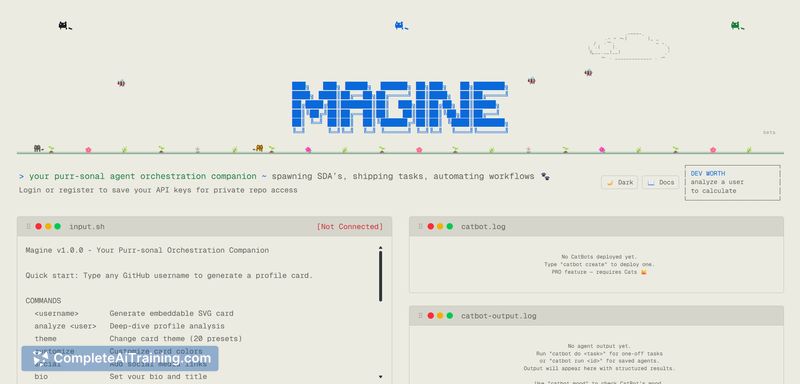
About Magine
Magine is a cloud platform that runs autonomous, vision-enabled AI agents which browse and act on the web like a human would. It combines screen-level perception with automation primitives so agents can click, log in, post, and follow multi-step workflows scheduled in plain English.
Review
Magine takes a different approach to browser automation by prioritizing visual perception over pure DOM scraping, which helps agents adapt when UI elements move or change. The product ships with a terminal-style UI, replayable action traces for visibility, and several cost-reduction techniques, but it remains an early-stage offering with some practical limits to note.
Key Features
- Vision-enabled autonomous browser agents that can observe the screen, plan actions, and perform clicks, inputs, and navigation.
- Natural-language scheduling - instruct agents in plain English to run recurring tasks or one-off jobs.
- Replayable action streams and step-level logs that record what the agent saw, how it reasoned, and the actions it took.
- Adaptive sampling and a Mixture-of-Experts pipeline to reduce token usage and route workloads to appropriate models.
- Terminal-style UI and cloud deployment built on technologies like Groq inference, Google Cloud Platform, and MongoDB.
Pricing and Value
Magine launched with a free tier and promotional tokens for early users, making it easy to prototype and test common automations. Operational cost is primarily driven by token consumption and inference usage, so teams should plan for usage-based pricing as they scale. For short-term experiments and lightweight monitoring tasks it offers strong value; for continuous, multi-agent deployments you should evaluate ongoing token and compute costs before committing.
Pros
- Vision-first agents are more resilient to UI changes than many DOM-dependent scripts.
- Plain-English scheduling and automation lower the barrier for non-engineers to create workflows.
- Action streams and frame-level logs provide transparency and make debugging easier.
- Cost-control features like adaptive sampling help limit unnecessary inference work.
- Useful for a variety of real use cases such as inbox triage, social media summaries, and dashboard monitoring.
Cons
- Token and inference costs can rise quickly for many concurrent agents or continuous frame capture.
- Authentication flows and some paywalled content remain occasional failure points.
- As an early-stage product, longer-term memory and cross-session consistency are still being improved.
Magine is best suited for developers, ops and growth teams, and automation-focused practitioners who need resilient browser automation or monitoring without building complex Playwright/Selenium scripts. Try the free tokens to validate workflows, but plan capacity and cost controls before scaling to continuous or high-volume runs. For demos and prototypes it is a strong, practical option; for large-scale automation you should evaluate stability and token economics in your specific scenarios.
Open 'Magine' Website
Your membership also unlocks: