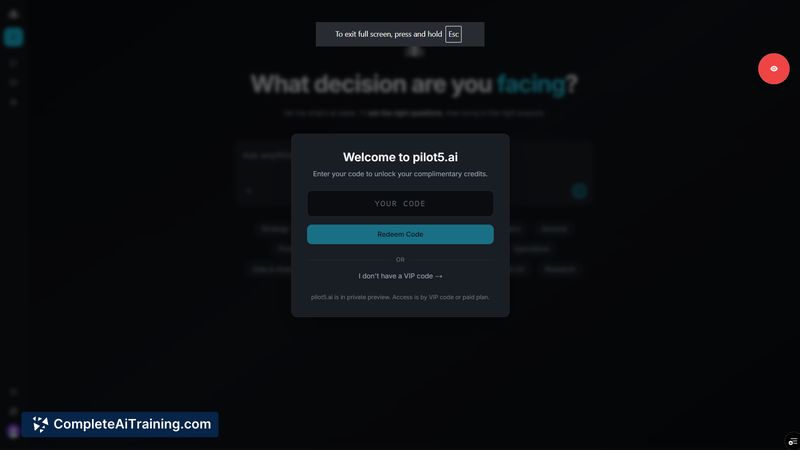
About Pilot5.ai
Pilot5.ai runs five independent AI models in parallel to provide multiple perspectives on a single question. Each model has a distinct role, they critique one another blind, and the service produces a synthesized recommendation with supporting dissent and falsification signals.
Review
Pilot5.ai targets decisions where a single confidently worded answer could be risky. By combining structured roles (e.g., structure, strategy, technical precision, risk, contrarian), it surfaces disagreements and delivers a clear recommendation plus the rationale and counterpoints.
Key Features
- Five independent AI perspectives working in parallel, each routed to a specific analytical role.
- Blind cross-examination followed by a synthesis round that yields a final recommendation.
- Actionable outputs: a GO / PIVOT / STOP verdict, a calibrated confidence score (0-10), and a Minority Report when views differ.
- Falsification conditions: three signals listed that would invalidate the recommendation.
- Three usage modes for different needs: The Expert, The A-Team, and The Dream Team.
Pricing and Value
Pilot5.ai uses a credit-based, pay-per-use model with some free options at launch. Deliberations consume more compute than single-model queries because multiple frontier models run in parallel; credits are metered to actual usage and excess charges may be refunded. The product positions itself for occasional, high-impact queries rather than routine drafting, aiming to reduce the cost of a wrong decision rather than compete on per-call price.
Pros
- Multiple independent perspectives reduce the chance of missing blind spots and provide transparent dissenting views.
- Clear, actionable outputs (verdict, confidence score, falsification conditions) help stakeholders make defensible decisions.
- Modes let you pick the intensity and composition of the panel to fit different problem types.
- Useful as a final-stage stress test or as a framing tool before deeper work with a preferred single model.
- Built with infrastructure choices that favor quick deployment and elastic scaling for variable workloads.
Cons
- Higher token and compute costs compared with single-model queries, making it impractical for everyday tasks.
- Longer turnaround and more complex outputs can require extra time to interpret for casual users.
- Availability and cost depend on access to multiple frontier models, which can fluctuate.
Ideal users are teams or individuals facing high-stakes decisions who want structured, multi-perspective analysis before committing to action. It works best as a periodic stress-test or framing step rather than a daily assistant, especially when the cost of a mistaken choice is significant.
Open 'Pilot5.ai' Website
Your membership also unlocks: