About Pushary
Pushary is a lock-screen control panel that routes permission prompts and questions from AI coding agents to a mobile device. It supports Claude Code, Codex, Cursor, Gemini CLI, Hermes, and Claude Cowork, consolidating approvals, denials, and task-done alerts into one inbox. The tool pairs with a terminal by scanning a QR code, and it enforces gating so a risky command blocks until you answer.
Review
Pushary addresses a specific friction point in agent-driven workflows: the run stops when the agent needs a decision, and the human isn't at the keyboard. Instead of mirroring an entire terminal session, it sends only the decision points-approvals, questions, and completion notices-to a phone's lock screen. This launch introduces native iPhone and Android apps, replacing the earlier web-push approach that the maker acknowledges was unreliable for iPhone users.
Key Features
- Lock screen approvals with enforced gating. For Claude Code, Codex, Gemini CLI, Cursor, and Hermes, a risky command is held at the hook level until you respond. Claude Cowork and claude.ai connect via a pasted link and ask cooperatively.
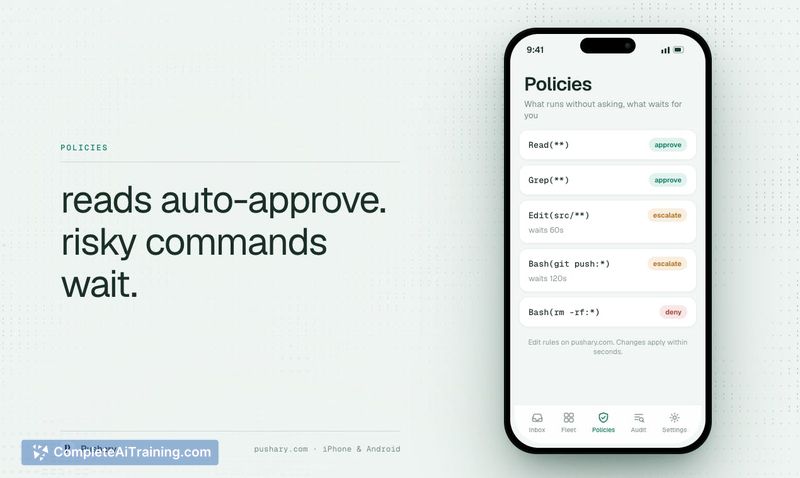
- Per-tool policies with path-level granularity. You can auto-approve safe reads (e.g., only under
src/) and deny dangerous operations outright. Rules match by specificity, and explicit rules override defaults. - One inbox across agents and machines. All approval requests, regardless of which agent or machine generated them, land in a single queue on the phone. You can also approve from a web dashboard or Slack.
- Exportable audit trail. Every question and answer is recorded with the specific target that matched a policy, not just a generic event. The trail can be exported for later analysis or compliance review.
- Multiple fallback channels. If the phone is unreachable, approvals can time out and fall back to the terminal, web dashboard, or Slack, depending on configuration.
Pricing and Value
Pushary costs $9.99 per month after a 7-day trial. The trial requires a credit card up front. A free tier is not mentioned in the current launch details. The pricing covers the native apps, policy engine, audit trail, and multi-channel fallbacks.
Pros
- Fail-closed design: missing or clearing a notification denies or waits, never auto-approves.
- Policy engine allows fine-grained control over which actions reach the phone, reducing noise.
- Works across six different agents from multiple vendors, not locked to a single tool or ecosystem.
- QR-code pairing removes the need to copy and paste API keys between terminal and phone.
Cons
- A lock-screen tap is a fast reflex, and for high-stakes commands like database migrations, the same one-tap flow used for trivial approvals may not give enough friction for careful review, even with a diff preview.
- Team approval routing to a specific teammate or a shared team inbox is not yet built, so the tool remains centered on a single account holder.
- Not well suited for users who want a full session mirror on their phone; Pushary sends only decision prompts, not the complete terminal output or agent thought process.
Pushary fits solo developers and small teams who run long agent tasks and need to stay unblocked while away from the terminal. The policy layer and audit trail also make it useful for anyone who wants a record of what their agents did and why. Teams that need delegated approvals or a shared decision queue will find the current version limited, but the maker has indicated those features are under consideration for future builds.
Open 'Pushary' Website
Your membership also unlocks: