About Revyl
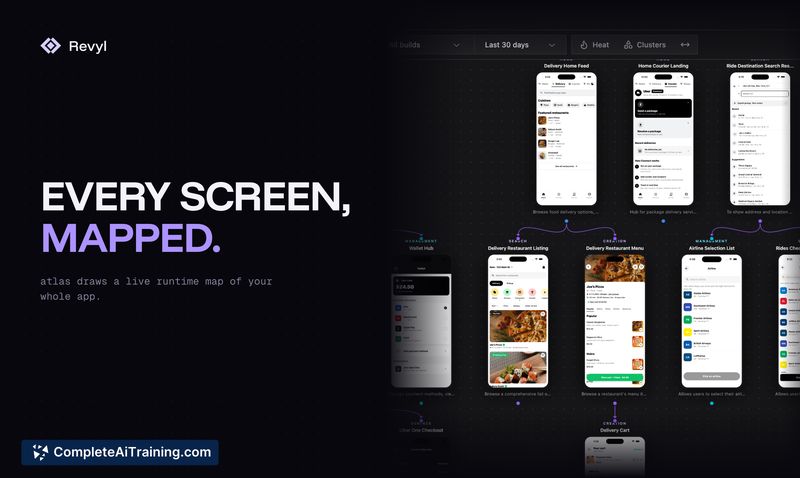
Revyl shows mobile teams how their app actually behaves on live cloud devices. It captures step-level execution traces, performance data (CPU, memory, FPS), a full network waterfall, and state and file-system diffs across runs. Atlas, a built-in component, auto-maps every screen and flow in the app, while the CLI lets developers or coding agents drive devices directly from the terminal.
Review
Revyl launched this week as a mobile source of truth, targeting teams that want to verify app behavior on real devices before release. The tool combines automated run capture with an agent-driven test approach and live device interaction. It's designed to slot into a development loop and CI pipeline rather than sit as a separate QA phase.
Key Features
- Step-level execution traces that include CPU, memory, and FPS data for each run.
- A complete network waterfall showing every request and response during a session.
- State and file-system diffing across runs to surface accumulating changes that are hard to debug otherwise.
- Atlas, which auto-maps every screen and flow in the app, producing a live diagram instead of a static document.
- A CLI with revyl dev that supports hot reload, device control, and a GitHub Action for gating merges based on test results.
Pricing and Value
Revyl currently has a free solo tier for one month. Longer-term pricing details are not yet publicly specified.
Pros
- Captures the full context of a run-step traces, performance metrics, network activity, and state diffs-so failures aren't just a pass/fail binary.
- Atlas automatically generates a visual map of screens and flows, keeping documentation aligned with the actual build.
- The CLI and GitHub Action let developers trigger cloud device runs from their terminal or CI, bringing testing closer to the code change.
- State and file-system diffing helps catch issues that accumulate between sessions, a class of bug that's typically difficult to reproduce.
Cons
- The product is brand new, so its long-term stability, documentation depth, and third-party integrations are still unproven.
- It is not well suited for teams that cannot use cloud devices or require on-premise testing infrastructure.
- Overly specific natural-language test steps can cause brittle results; the tool works best with vague instructions, which may not fit teams that need precise, repeatable UI scripts.
Revyl fits mobile teams that want to shift testing earlier and need detailed diagnostics from cloud device runs. It works well for developers using AI coding agents who can trigger runs from the CLI and get immediate feedback. Teams that rely on manual QA or on-premise device farms may find less immediate utility.
Open 'Revyl' Website
Your membership also unlocks: