About SeaTicket
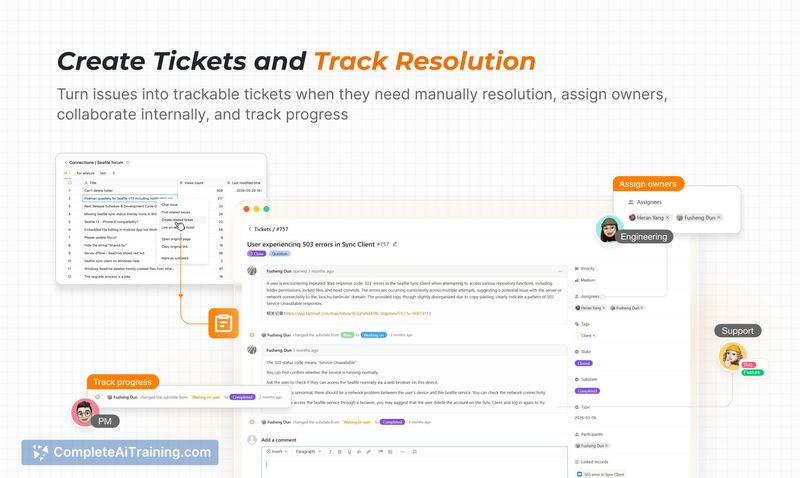
SeaTicket is an AI-driven support tool that aggregates issues from channels like GitHub, Discourse, and email into a single workspace. It assembles related documents and prior reports so teams have the context they need when addressing a customer issue.
Review
SeaTicket targets the common problem of fragmented support signals by pulling related threads and documentation together and using built-in AI agents to suggest possible resolutions. This review covers the main features, pricing signals, strengths, and limitations to help teams decide whether the tool fits their workflow.
Key Features
- Cross-channel synchronization: consolidates issues and messages from GitHub, Discourse, and email into one workspace.
- Full context assembly: surfaces related issues and documents alongside the current ticket so responders don't have to search manually.
- AI agents for resolutions: agents propose draft responses and remediation steps by reasoning over prior issues and documentation.
- Hybrid search and re-ranking: combines keyword and vector search with an LLM re-ranking step and can issue multiple queries to gather sufficient context.
- Action capabilities: can update issue state and labels automatically, while recommending manual review for outgoing responses.
Pricing and Value
SeaTicket offers a free option and a no-credit-card-required trial, making it easy to test core functionality. The public information on tiered pricing beyond the free option is limited; teams that need enterprise features, larger data retention, or advanced automation should consult the provider for detailed pricing. The core value is in saving time and reducing context switching by turning historical support work into active, searchable context.
Pros
- Centralizes scattered support signals so teams see a single, unified view of an issue.
- Automated context retrieval reduces time spent hunting for relevant past tickets and docs.
- Search approach (keywords + vectors + LLM re-ranking) improves the relevance of retrieved items.
- Supports automated state changes (labels, issue status) to reduce routine manual work.
- Free trial lowers the barrier to evaluate fit with existing workflows.
Cons
- Public details on paid plans and limits are sparse, so cost for larger teams is unclear without contacting sales.
- Automations that change external systems can introduce risk if not carefully audited; some workflows require human review.
- Effectiveness depends on the quality and quantity of past issues and documentation-poor historical data will limit the agent's usefulness.
Ideal users are support, engineering, and product teams that manage community or open-source support across multiple channels and want to reduce repeated context gathering. SeaTicket is worth trying if your team spends significant time correlating reports across tools; evaluate the automation controls and pricing for larger deployments before committing.
Open 'SeaTicket' Website
Your membership also unlocks: