AI tool
Viggle JST-2
Viggle JST-2 is a physics-native world foundation model that generates 3D scenes, characters, and full-body motion from text, images, or video. It is built for developers and creators who need rapid 3D content generation through a browser app, API...
About Viggle JST-2
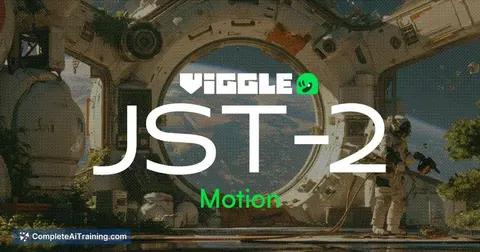
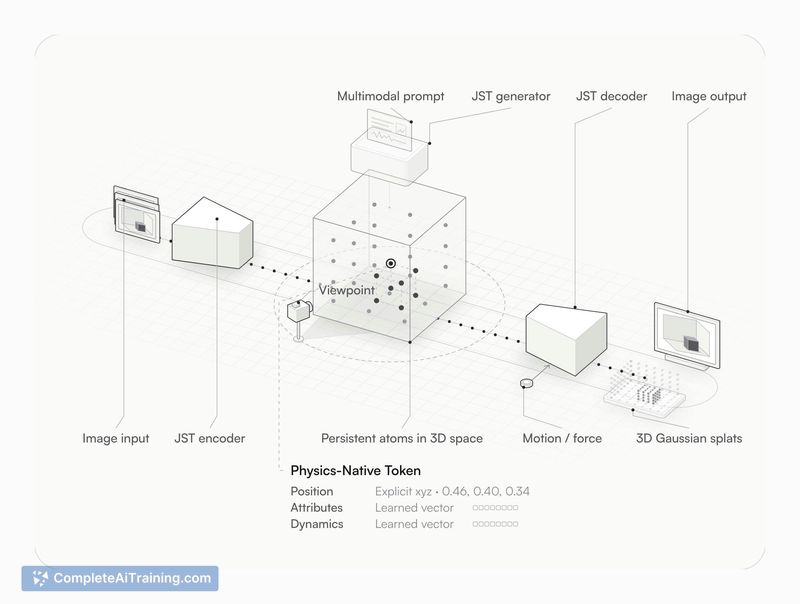
Viggle JST-2 is a physics-native world foundation model that generates 3D scenes, full-body characters, and motion within a single shared 3D world. Built on the Joint-Space-Time (JST) architecture, it represents the world as persistent 3D "atoms" with learned attributes and dynamics, encoding them as Physics-Native Tokens before decoding to images or 3D Gaussian splats. The model powers the PINOC browser app, an API, and MCP support for agents like Claude Code and Codex.
Review
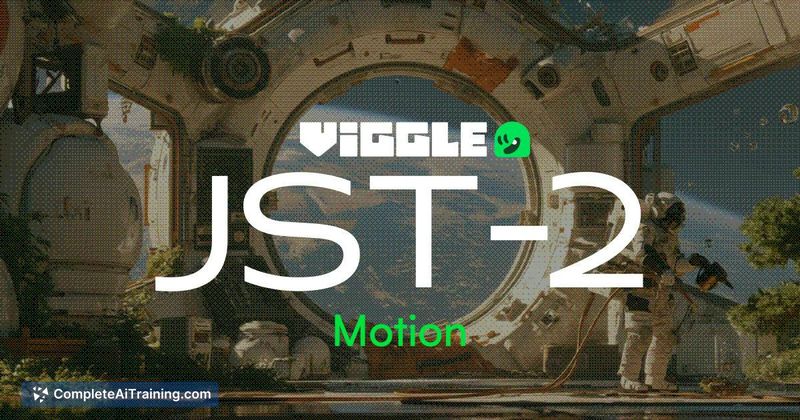
JST-2 attempts to collapse a multi-tool 3D pipeline into one model. Instead of moving between separate software for scene building, character modeling, rigging, and animation, users work from a single system that handles all three outputs. The approach centers on speed and physics awareness, with scenes reportedly generating in about one second.
Key Features
- Scenes: Generate a 3D scene from text prompts or images, expand a world one view at a time (up to 64 input views), or reconstruct real environments from sparse images for robot simulation.
- Characters: Full-body 3D characters from a single image or text description, including cropped or partly hidden inputs. The model produces detailed faces and individual finger movement without a separate rigging step.
- Motion: Full-body 3D motion applied directly to JST-2 characters from a text sentence or video clip. The motion output is also compatible with standard 3D rigs.
- PINOC browser app: A free web application with Scene mode and Agent mode for interacting with the model.
- API and MCP support: Programmatic access for integration with external agents, including Claude Code and Codex.
Pricing and Value
PINOC, the browser app for JST-2, is available as a free option at launch. The reference content does not define API pricing tiers, rate limits, or export caps. One community question asks whether PINOC remains free without limits or if caps apply when exporting characters for real projects, but no official answer has been posted. Inference cost for scenes is stated as below $0.01 per scene, though it's unclear if this reflects user-facing pricing or internal compute cost.
Pros
- Generates scenes, characters, and motion from one model, removing the need to stitch together separate tools for rigging and skinning.
- Scene generation speed is roughly one second, compared to about 5-6 minutes for Marble, based on Viggle's own benchmarks.
- Characters come with motion built in, so no external rigging or skinning step is required.
- PINOC provides a free browser-based entry point with no local installation.
- MCP support allows the model to work with coding agents, which may fit into automated 3D pipelines.
Cons
- Benchmarks are based on Viggle's own blind human tests rather than independent third-party evaluations, so comparative performance against Meshy 7.1, Tripo H3.1, HY-Motion-1.0, and DeepMotion Animate 3D should be interpreted with that in mind.
- Pricing beyond the free PINOC app remains undefined. Teams planning production use won't know API costs, export limits, or commercial terms without contacting Viggle directly.
- This tool is not well suited for projects that require precise, frame-level control over traditional animation curves or rigs. The model generates motion from text or video, which may not match workflows where animators need to fine-tune every joint manually.
JST-2 fits teams who need rapid 3D scene and character generation without running separate tools for modeling, rigging, and motion. It may also work for robotics simulation where reconstructing environments from sparse images matters. Small studios or individual 3D artists who rely on granular control over rigs and animation curves will likely find the text-and-video-driven motion approach too coarse for their needs.